EN
EN

Flexible Occupancy Sensor for Smart Home IoT | VMANX
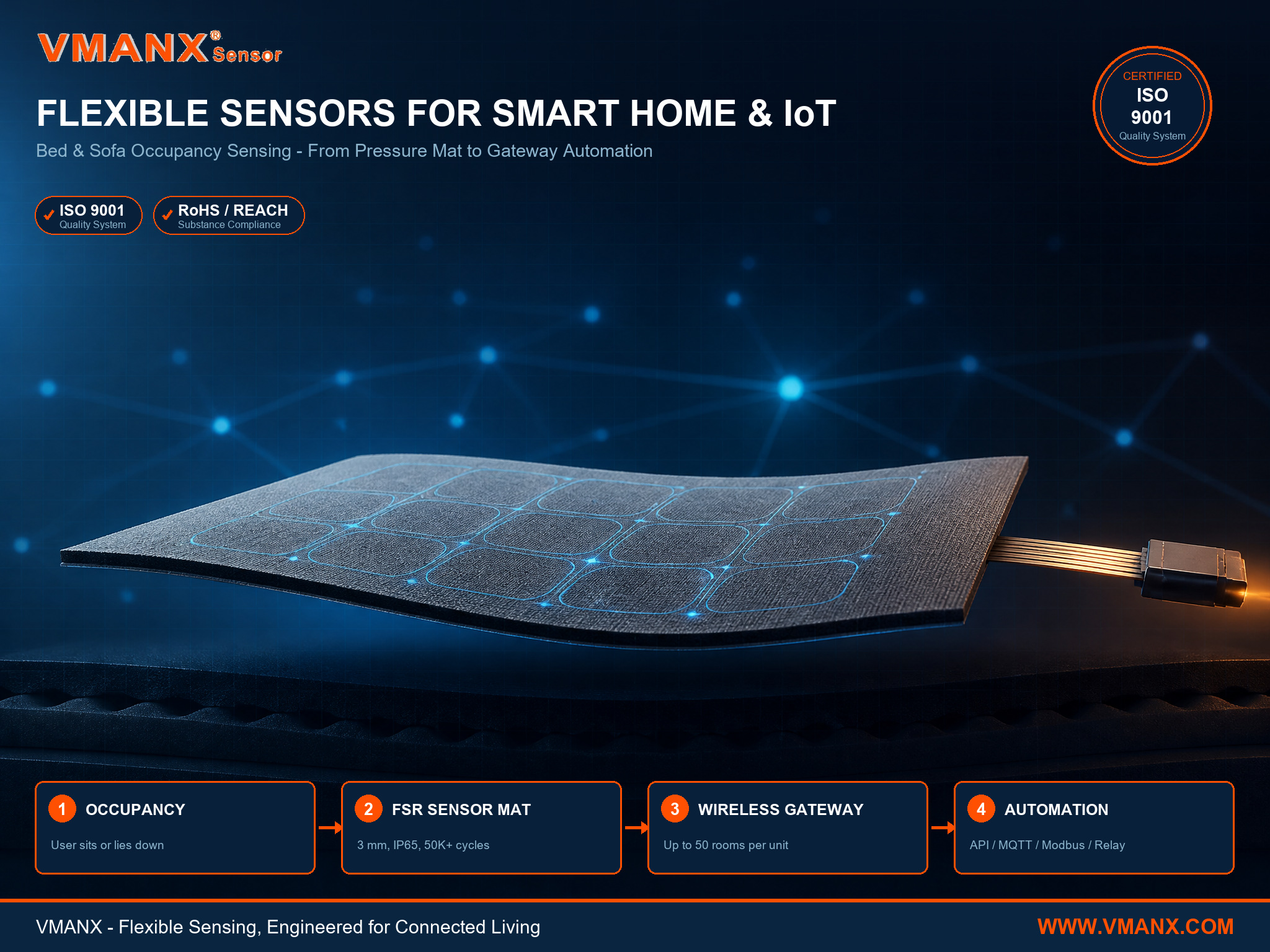
VMANX, an ISO 9001-certified printed electronics manufacturer in Dongguan, China, supplies flexible occupancy sensors for smart home and building IoT — a thin-film FSR sensor mat that hides inside sofa cushions and mattresses, because presence is the one input that lets home automation act on its own instead of waiting to be told. Built for furniture brands, smart-mattress makers and senior-living integrators, the platform pairs a 3 mm IP65 detection mat rated beyond 50,000 cycles with a multi-protocol gateway serving up to 50 rooms and reporting occupancy in real time.
Presence Is the Trigger Automation Has Been Missing
Most smart homes still wait for instruction. A user reaches for a phone, taps an app or speaks a command — the house does nothing until asked. That is not automation, it is a remote control with extra steps.
Occupancy changes the model. The moment someone sits on the sofa or gets out of bed is an unambiguous physical event, and unlike a motion sensor it carries state: not “something moved” but “this seat is occupied, and has been for 40 minutes.” From that single input a system can wake a TV, raise ambient lighting, trigger a night light, log sitting duration, or alert a caregiver that a resident has left the bed and not returned.
The reason presence sensing has been under-used is not concept, it is form factor. A rigid sensor changes how a cushion feels, and end users reject furniture that feels instrumented. That is the constraint printed flexible sensing removes.
Key Features & Benefits
Invisible Integration Between Foam Layers
The seat occupancy sensor is a flat, silicone-sealed switch pad designed to be embedded between cushion foam layers. Its ultra-thin profile means the end user never feels it and never sees it — the furniture behaves normally, and the sensing layer simply disappears into the build.
For a sofa brand, this is the difference between a product feature and a product compromise. The sensing capability is added during assembly without redesigning the cushion stack, changing the seat feel, or exposing hardware the customer has to look at.
Silicone-Sealed Against Moisture and Compression Fatigue
Home and care environments are hostile to electronics in a quiet way — spills, humidity, and above all relentless compression. Every time a user sits down, the sensing layer takes the full load.
The pad body is silicone-sealed to resist moisture and long-term compression cycles, and the detection mat is rated IP65 with a service life beyond 50,000 cycles. Sitting and standing perhaps thirty times a day, that endurance envelope covers years of normal residential use before degradation becomes a design concern.
Sealed Industrial Connector — No Custom Harness
The pad ships with a multi-channel harness terminated in a sealed industrial connector that plugs directly into the customer's controller. Multi-channel wiring lets a single harness serve several sensing zones, which matters for multi-seat sofas and split mattresses where left and right sides must be reported independently.
For the integrator this removes a hidden cost. Connector engineering, strain relief and sealing are already solved, so the sensing layer is a drop-in part rather than a sub-project.
Three-Layer Architecture From Mat to Dashboard
The bed occupancy system is delivered as three defined layers rather than a bare component:
● Detection layer — FSR sensor mat, 3 mm, IP65, 50,000+ cycles
● Network layer — wireless transmitter plus multi-protocol gateway, up to 50 rooms per unit
● Application layer — real-time dashboard with RESTful API, MQTT, Modbus and relay output
That structure is what makes the platform deployable at building scale. A single gateway covering 50 rooms turns a per-bed sensor into a facility-wide system, and four parallel integration paths mean it can join almost any existing stack — RESTful API for cloud platforms, MQTT for IoT brokers, Modbus for building management systems, and a dry relay contact for legacy nurse-call or alarm panels that speak no protocol at all.
Two Deployment Positions, One Sensing Platform
The same technology serves two distinct placements. In a sofa, the pad sits between cushion foam layers and detects the moment a user sits down — triggering ambient lighting, TV wake-up or occupancy analytics. In a mattress, it sits between the comfort layer and the support core, and knows when the user gets in and out of bed — powering sleep-stage automation, night-light control and elderly-care alerts.
Same sensing principle, same integration approach, two very different product categories reachable from one supply relationship.
Technical Specifications
| Parameter | Specification |
| Sensing Principle | Force sensing resistor (FSR), printed thin-film |
| Detection Layer | FSR sensor mat |
| Mat Thickness | 3 mm |
| Ingress Protection | IP65 |
| Cycle Life | 50,000+ cycles |
| Sofa Pad Construction | Silicone-sealed switch pad, flat and flexible |
| Sofa Pad Placement | Embedded between cushion foam layers |
| Mattress Placement | Between comfort layer and support core |
| Harness | Multi-channel, sealed industrial connector |
| Controller Interface | Direct plug-in to customer controller |
| Network Layer | Wireless transmitter + multi-protocol gateway |
| Gateway Capacity | Up to 50 rooms per unit |
| Application Layer | Real-time dashboard |
| Integration Protocols | RESTful API, MQTT, Modbus, relay output |
| Sofa Applications | Ambient lighting, TV wake-up, occupancy analytics |
| Mattress Applications | Sleep-stage automation, night-light control, elderly-care alerts |
| Environmental Resistance | Moisture and long-term compression cycles |
| Quality System | ISO 9001 |
| Substance Compliance | RoHS, REACH |
Typical values. Supplied as an OEM component and system platform — whole-device certification is performed by the brand placing the finished product on the market.
Why Force Sensing Rather Than Radar or PIR
Each presence technology fails differently, and the failure mode should decide the choice.
PIR motion sensors detect movement, not occupancy. A person sitting still reading a book stops existing as far as PIR is concerned, which is precisely wrong for sofa and bed applications where stillness is the normal state.
Radar and mmWave detect presence without contact and can sense through materials, but they see everything in range — including a person walking past the doorway, a pet on the floor, or movement in the adjacent room through a stud wall. Discriminating the target requires processing, tuning and a per-installation calibration burden.
A pressure mat answers a narrower question and answers it definitively: is there weight on this specific surface. It cannot be confused by a passing pet or a neighbour through a wall, because load on the cushion is load on the cushion. For applications where the question is genuinely “is this seat or bed occupied,” that specificity is an engineering advantage, not a limitation.
The honest trade-off is that a pressure mat only senses where it is installed. It will not tell you where someone is in a room. When the requirement is room-level tracking rather than surface-level occupancy, a different sensing modality is the right answer — and saying so is part of specifying a system properly.
Customer FAQs
Q: Will the sensor change how the sofa or mattress feels?
A: No. The pad is a flat, flexible, ultra-thin silicone-sealed body designed to sit between foam layers. It is intended to be invisible to the end user in both look and feel, so the cushion stack behaves as designed.
Q: How long will it last under daily use?
A: The detection mat is rated beyond 50,000 compression cycles. For a seat used roughly thirty times a day, that corresponds to years of normal residential service before degradation becomes a design consideration.
Q: Can one gateway cover a whole care facility?
A: A single gateway unit supports up to 50 rooms. Larger deployments scale by adding gateway units, which keeps the network layer proportional to building size rather than requiring one controller per bed.
Q: How does it connect to our existing platform?
A: Four integration paths are provided — RESTful API, MQTT, Modbus and relay output. Cloud platforms typically use the API, IoT deployments use MQTT, building management systems use Modbus, and legacy alarm or nurse-call panels use the dry relay contact.
Q: Can it report multiple zones independently?
A: Yes. The harness is multi-channel, so a multi-seat sofa or a split mattress can report each zone separately through a single sealed connector rather than running independent cable assemblies.
Q: Is it waterproof enough for a care environment?
A: The detection mat is rated IP65 and the sofa pad body is silicone-sealed against moisture, which addresses spills and humidity typical of residential and care settings.
Q: What certification does the product carry?
A: VMANX manufactures under an ISO 9001 quality management system with RoHS and REACH substance compliance. The sensor is supplied as an OEM component and system platform; certification of the finished furniture, mattress or care product is performed by the brand bringing it to market.
Q: Can the mat size and force threshold be customised?
A: Yes. Active area, mat dimensions, trigger threshold, harness length, channel count and connector type are all configurable for OEM programs. The printed sensing platform stays the same while geometry and calibration adapt to the target product.
OEM Engineering Support
VMANX supports smart home and IoT programs from placement definition through production release, covering mat sizing, trigger threshold calibration for the target cushion stack, harness routing, connector selection and gateway integration. Product data is published on the home intelligence category, with detail on the VMANX bed occupancy sensor and the smart sofa seat occupancy sensor. The underlying force sensing resistor technology and the wider electronic and electrical appliances range are built on the same flexible printed circuits platform.
Conclusion
Smart homes have no shortage of outputs. What they lack is a reliable, unobtrusive input that tells the system a person is actually there. A 3 mm IP65 pressure mat rated beyond 50,000 cycles, sealed against moisture and compression, hidden between foam layers and reporting through API, MQTT, Modbus or relay, turns presence into a signal the building can act on — manufactured under ISO 9001 control so behaviour repeats from batch to batch.