EN
EN

VMANX Launches Sub-1.2 mm FSR Pillow Sensing Platform
Dongguan, China — VMANX INDUSTRIAL CO., LIMITED has released an OEM printed force-sensing platform for smart pillows that maps head pressure, classifies sleeping posture and recovers respiration and heart rate without touching the sleeper. Built on a flexible screen-printed FSR array under 1.2 mm thick, the platform lets bedding brands, elderly-care providers and sleep-clinic integrators add clinical-grade sleep sensing to existing pillow designs without changing how the pillow feels.
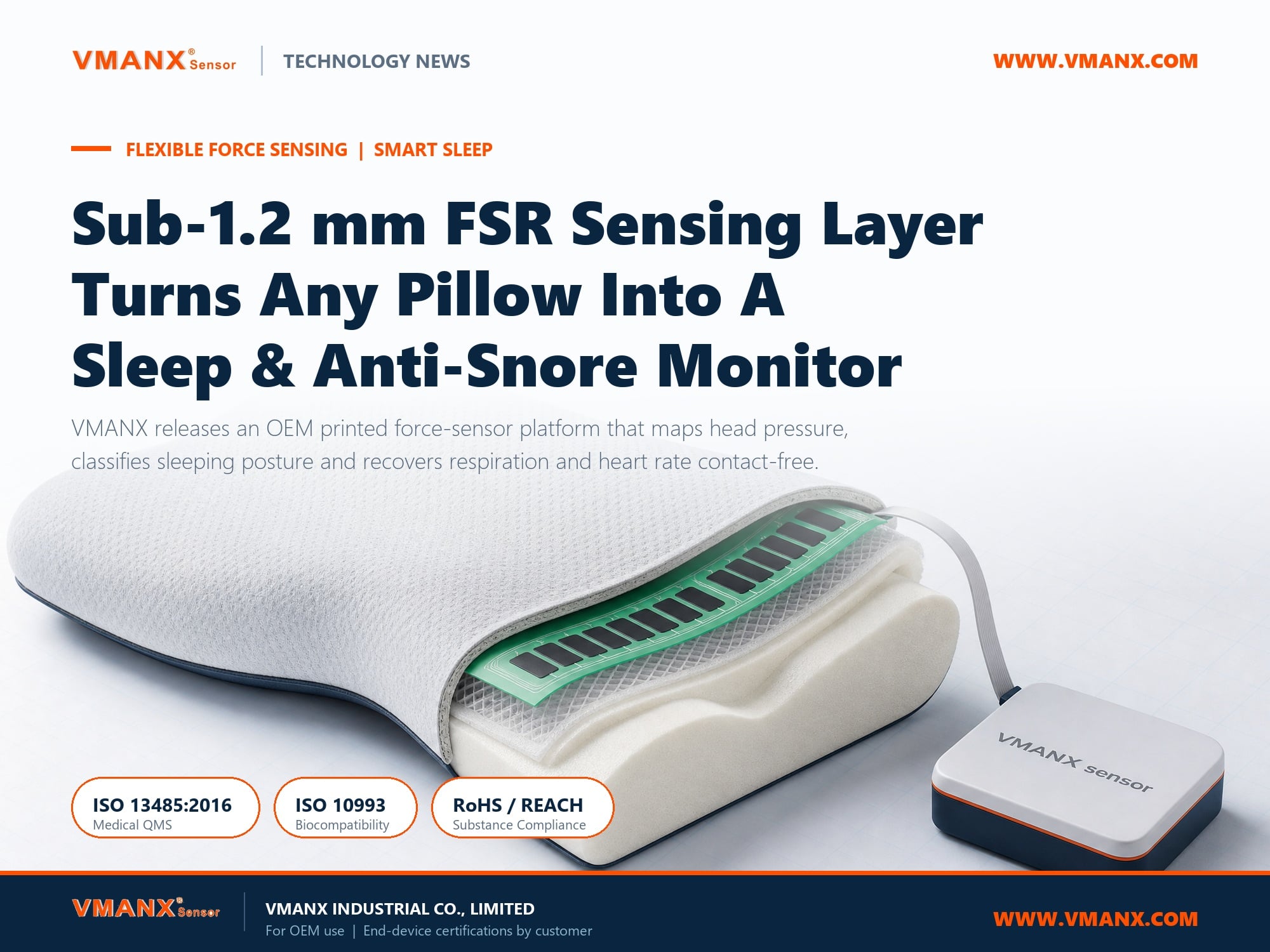
The VMANX smart pillow sensing platform: a sub-1.2 mm printed FSR layer with a compact acquisition module.
Why Pressure, Not Sound
Most anti-snore products on the market listen. A microphone detects the noise, then the system reacts — which means intervention always arrives after the airway has already collapsed and the sleeper has already been disturbed.
A pressure-sensing layer changes the order of events. Because supine posture is the mechanical precondition for most positional snoring, a sensor that resolves head-load distribution can identify the risk posture before the acoustic event occurs. That is what makes genuine closed-loop intervention possible rather than reactive noise masking.
"Acoustic detection tells you snoring happened. Pressure distribution tells you why it is about to happen. For customers building actuator-equipped pillows, that difference decides whether the product actually works."
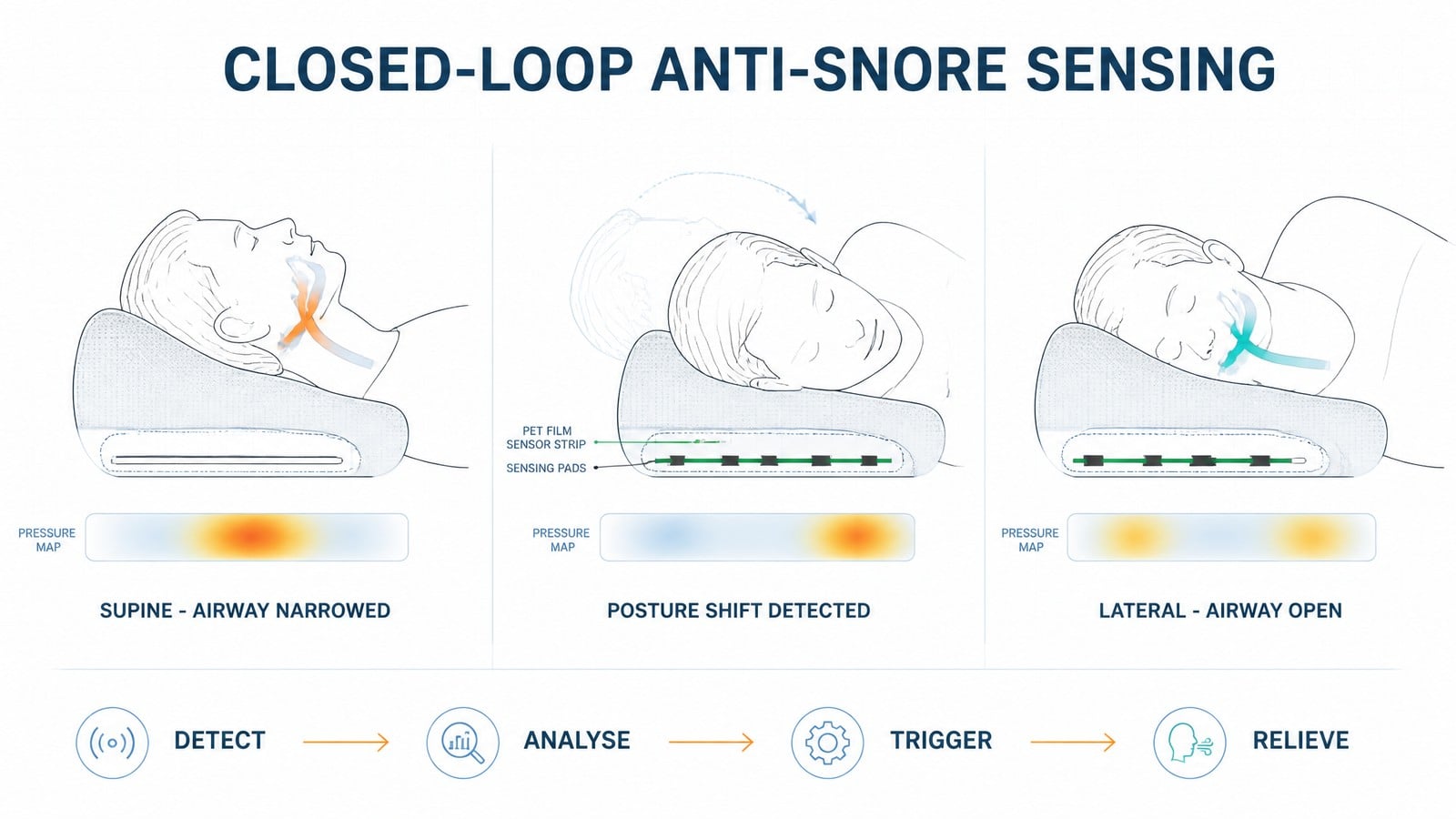
Closed-loop anti-snore logic: supine posture narrows the airway, the sensor detects the load-pattern shift, and the customer's actuator is triggered before the acoustic event.
Three Signal Domains From One Printed Layer
A common misconception in sleep-product development is that pressure mapping, posture tracking and vital-sign monitoring each require separate hardware. The VMANX platform resolves all three from a single printed sensing layer by separating the signal by time constant:
● Static load — resistive matrix output resolves head and neck pressure into a live distribution map with peak-zone detection, supporting pressure-relief analysis and pillow-height fitting.
● Slow posture change — load-pattern classification separates supine, left, right and prone states, logging turn intervals and triggering the customer's actuator when a snore-risk posture persists.
● Micro-vibration — ballistocardiographic content is filtered from the same channels to recover respiration and heart rate fully contact-free, with no electrodes attached to the sleeper.
Consolidating three functions onto one layer removes redundant hardware from the customer's bill of materials and eliminates the sensor-fusion complexity of combining separate pressure, motion and vital-sign modules.
Construction: Invisible To The Sleeper
The sensing stack laminates into the pillow at under 1.2 mm total build height. There is no rigid board and no hard edge beneath the head — the layer is designed to be mechanically undetectable in use, which is the practical requirement for any sensor placed under a sleeping person’s neck.
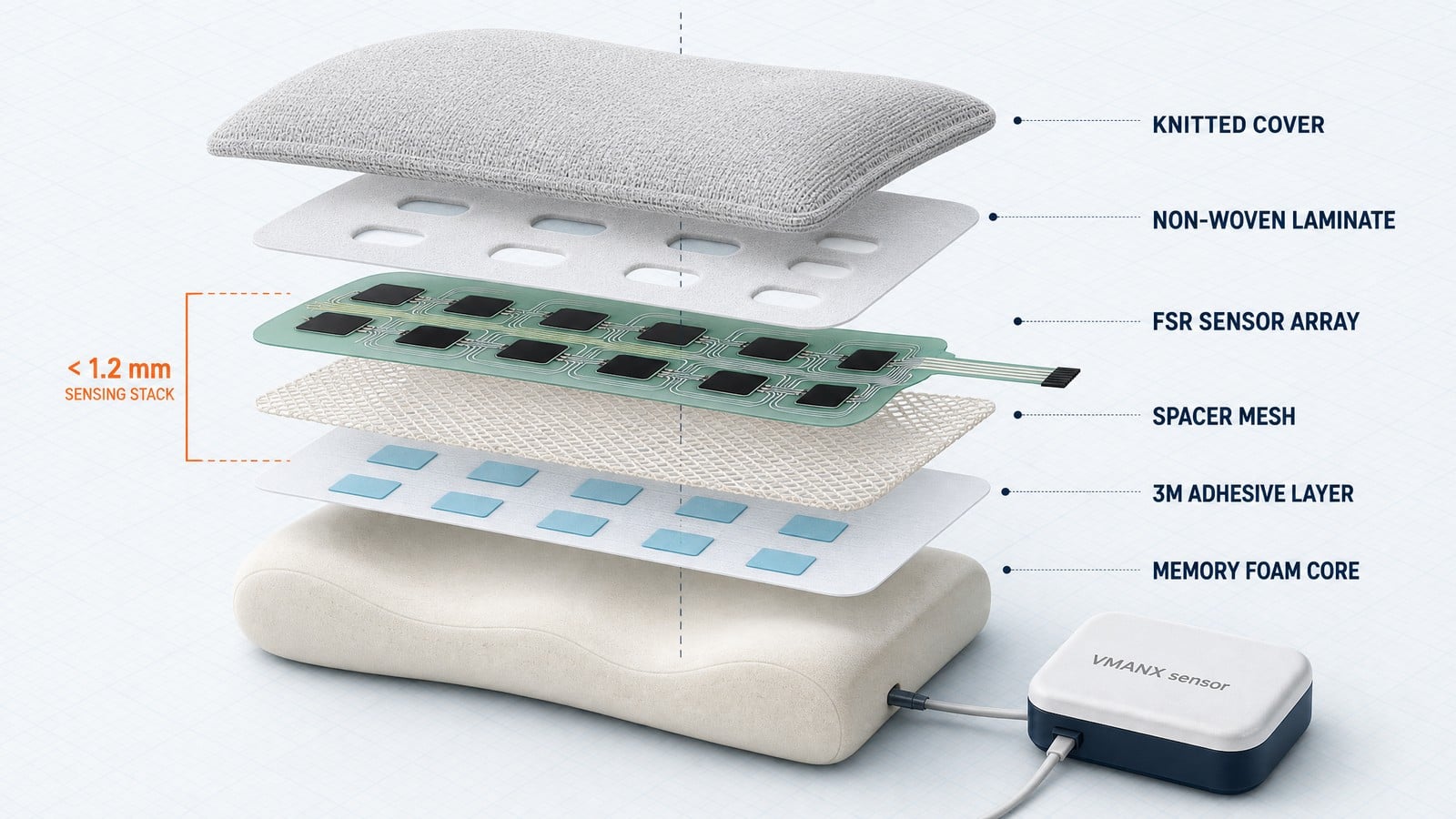
Layer construction: knitted cover, non-woven laminate, printed FSR sensor array, spacer mesh, 3M adhesive layer and memory-foam core.
The platform ships in two formats built on the same signal chain. A linear FSR strip array carries ten discrete sensing pads on a flexible PET substrate with an FFC tail, sized for the pillow centre line. A shaped multi-zone mat uses a non-woven laminated matrix with spacer-mesh isolation and 3M 9448A adhesive mounting, die-cut to a free-form outline for shoulder, neck and upper-back coverage.
Technical Specifications
| PARAMETER | SPECIFICATION |
|---|---|
| Sensing technology | FSR piezoresistive matrix, screen-printed |
| Sensing points | 10 standard, up to 32 customisable |
| Active area | Strip 18 x 240 mm / mat free-form die-cut |
| Total thickness | < 1.2 mm stack, 0.325 mm sensor film |
| Pressure range | 0 – 100 kPa (extendable on request) |
| Full-scale accuracy | ± 3 % FS after calibration |
| Response time | < 10 ms |
| Sampling rate | Up to 100 Hz per full frame |
| Respiration range | 6 – 40 rpm, contact-free |
| Heart-rate range | 35 – 150 bpm, ballistocardiographic |
| Posture states | Supine / left / right / prone |
| Substrate material | Flexible PET film, silver + carbon printed |
| Isolation layer | Spacer mesh, non-woven laminate |
| Mounting | 3M 9448A double-sided adhesive |
| Operating temperature | −20 °C to +60 °C |
| Durability | > 1,000,000 press cycles |
| Interface | FFC 1.0 mm / USB / UART / RS-485 / BLE optional |
| Power supply | DC 5 V, < 2.0 W typical |
Host Software And Integration
The platform ships with host monitoring software that renders the head pressure heat map alongside vital-sign values, a posture timeline and a snore-event log. The full data protocol and an SDK are released to customers, so the sensing layer can feed an existing brand application or cloud platform rather than forcing a parallel software stack.
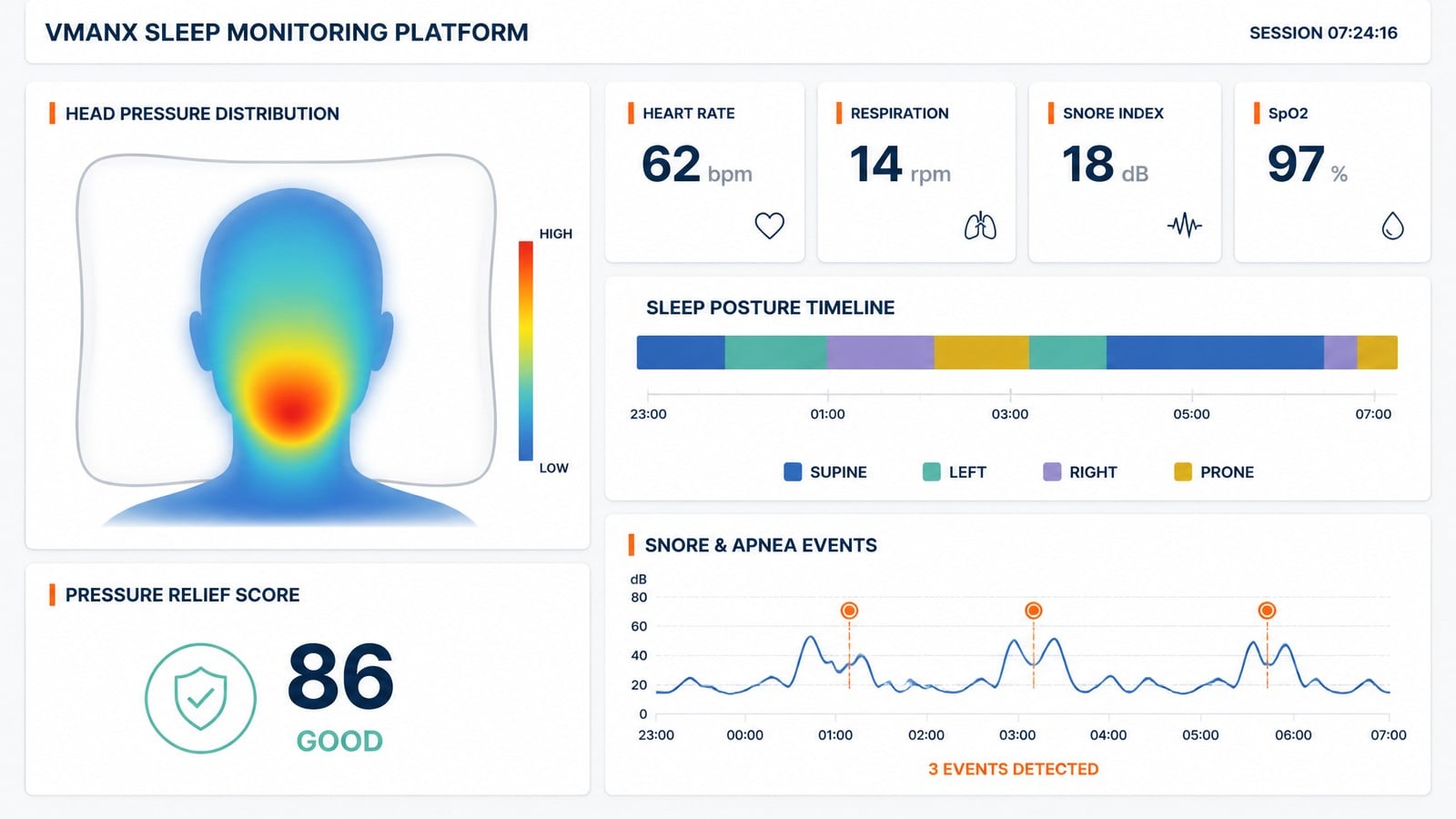
Host monitoring platform: head pressure distribution, real-time vital signs, sleep posture timeline and snore-event logging.
For customers who require a branded deliverable, the host UI is re-skinned with the customer's identity, language and report layout, and the pressure, posture and vital-sign algorithms can be ported to the customer's own platform.
Manufactured In-House
Silver and carbon conductive inks are screen-printed onto flexible film on VMANX's own roll-to-roll line, laminated with multi-layer alignment within ± 0.10 mm, then subjected to 100 % electrical continuity and optical trace inspection before every unit is pressure-calibrated ahead of shipment.
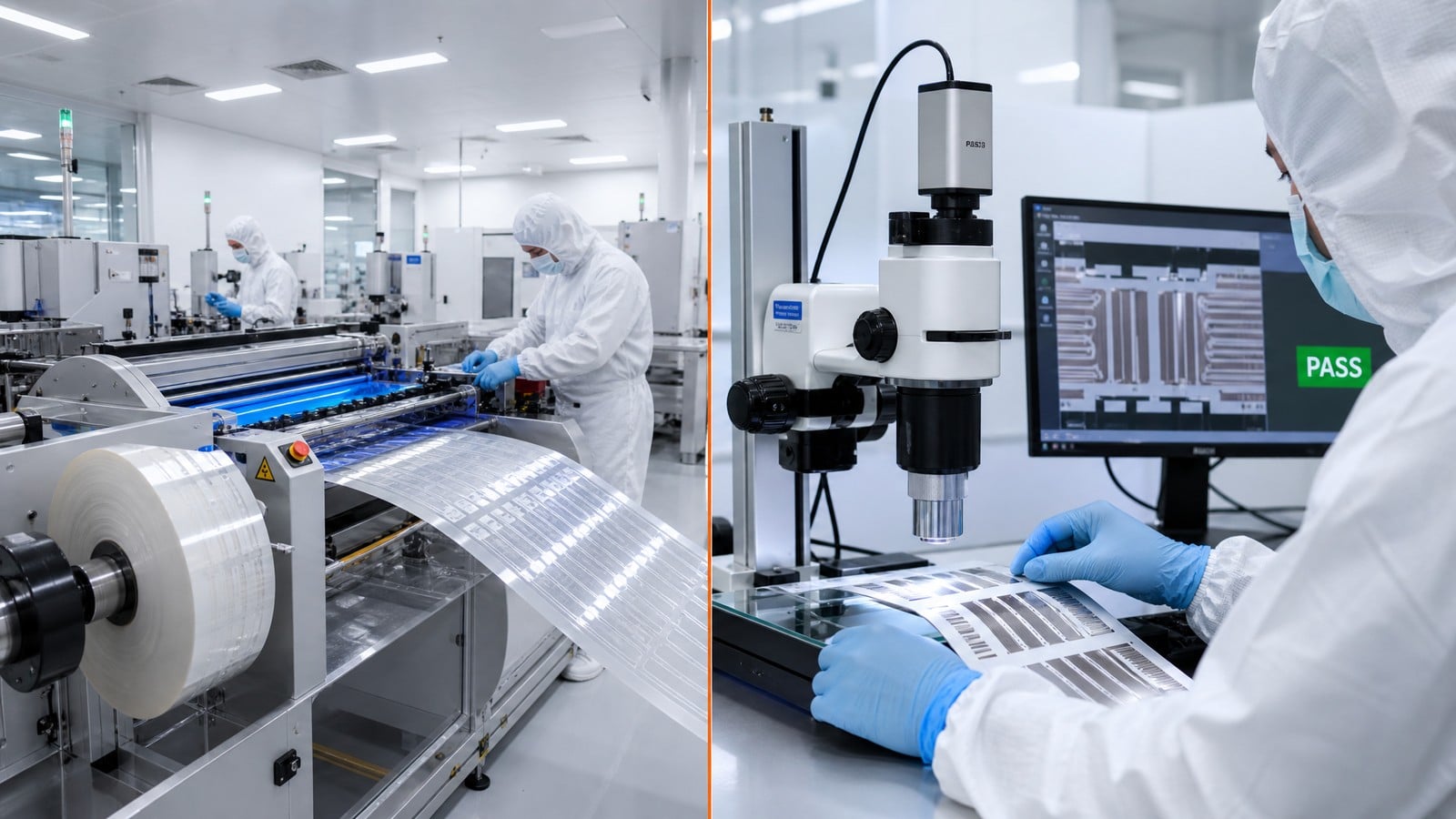
Cleanroom roll-to-roll screen printing and 100 % electrical and optical inspection.
Controlling the printing process in-house is what allows pad count, active area, outline geometry and connector type to be built to a customer drawing rather than selected from a fixed catalogue. Engineering samples are delivered in 10 – 15 days and pilot production in 25 – 30 days.
Applications
● Smart home bedding — sleep staging, snore reporting and adaptive height control delivered through the brand's own application, with the sensing layer imperceptible to the user.
● Elderly and nursing care — contact-free respiration and heart-rate monitoring, turn-interval logging and head-off-pillow detection, reducing night rounds and pressure-ulcer risk.
● Sleep laboratories and clinics — objective posture and head-load data added to polysomnography without attaching further electrodes to the patient.
● Bedding retail — a 60-second in-store head pressure scan that converts pillow-height selection into visual, data-backed advice.
Quality And Compliance
VMANX manufactures under a medical-device quality management system and supplies biocompatible skin-contact materials with full substance-compliance documentation:
● ISO 13485:2016 — medical device quality management system
● ISO 10993 — biological evaluation of medical devices, biocompatibility
● RoHS / REACH — substance compliance for the EU market
Certification and compliance documentation is issued per project scope and provided during technical review.
For OEM Use. End-Device Certifications by Customer. Certifications such as CE MDR and FDA clearance apply to the finished device and are held by the customer placing the product on the market.
About VMANX
VMANX INDUSTRIAL CO., LIMITED is a flexible sensor and printed electronics manufacturer based in Dongguan, China, supplying force-sensing resistors, membrane switches, flexible printed circuits and human-machine interface assemblies to medical, automotive and industrial customers worldwide.