EN
EN

One Flexible Sensor for EEG + PPG Integration
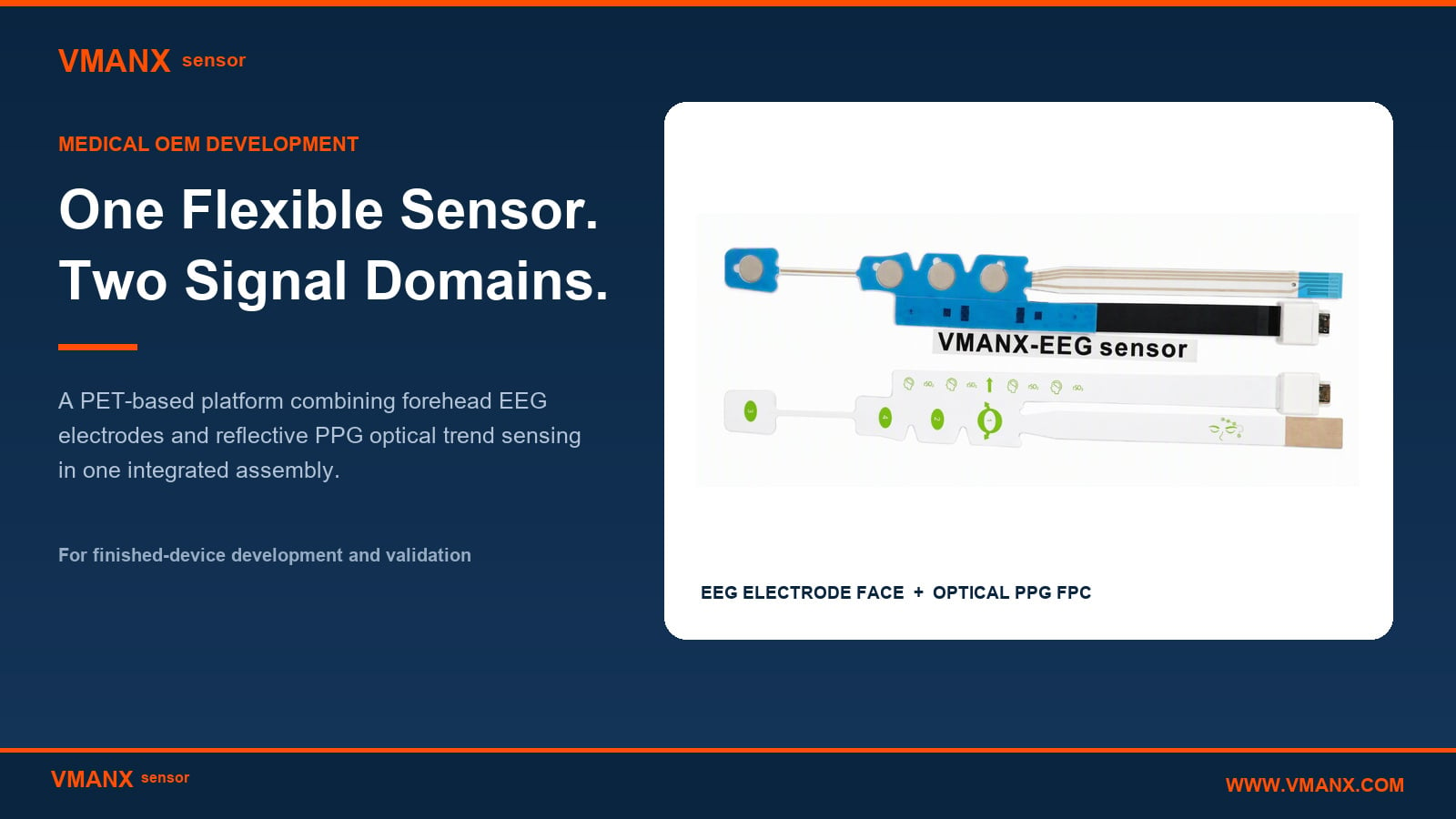
A PET-based platform combining forehead EEG electrodes and reflective PPG optical trend sensing.
DONGGUAN, China — September 23, 2026 — VMANX INDUSTRIAL CO., LIMITED has developed a flexible medical-sensing platform that brings forehead EEG electrodes and reflective PPG optical trend sensing into one PET-based assembly. Created for medical-device OEM development, the concept addresses a practical integration challenge: how to acquire complementary electrical and optical waveforms through one low-profile forehead interface while keeping signal conditioning, algorithms and final clinical claims within the finished-device manufacturer’s validation process.
Why bring EEG and PPG into one forehead interface?
EEG and PPG observe different physiological phenomena. EEG electrodes acquire low-level biopotential signals associated with cerebral electrical activity. Reflective PPG uses light emitters and a photodetector positioned on the same side of the tissue to capture pulsatile changes in returned light.
In many monitoring workflows, these functions are implemented as separate sensors with separate placement steps, cables and mechanical interfaces. A shared flexible assembly can simplify the physical integration task for OEM teams by registering the electrode region and optical region within one forehead-format platform.
The intent is not to combine two signals into a single measurement. Instead, the architecture keeps the electrical and optical paths functionally distinct at the sensor while allowing the host device to synchronize the resulting waveforms for application-specific analysis.
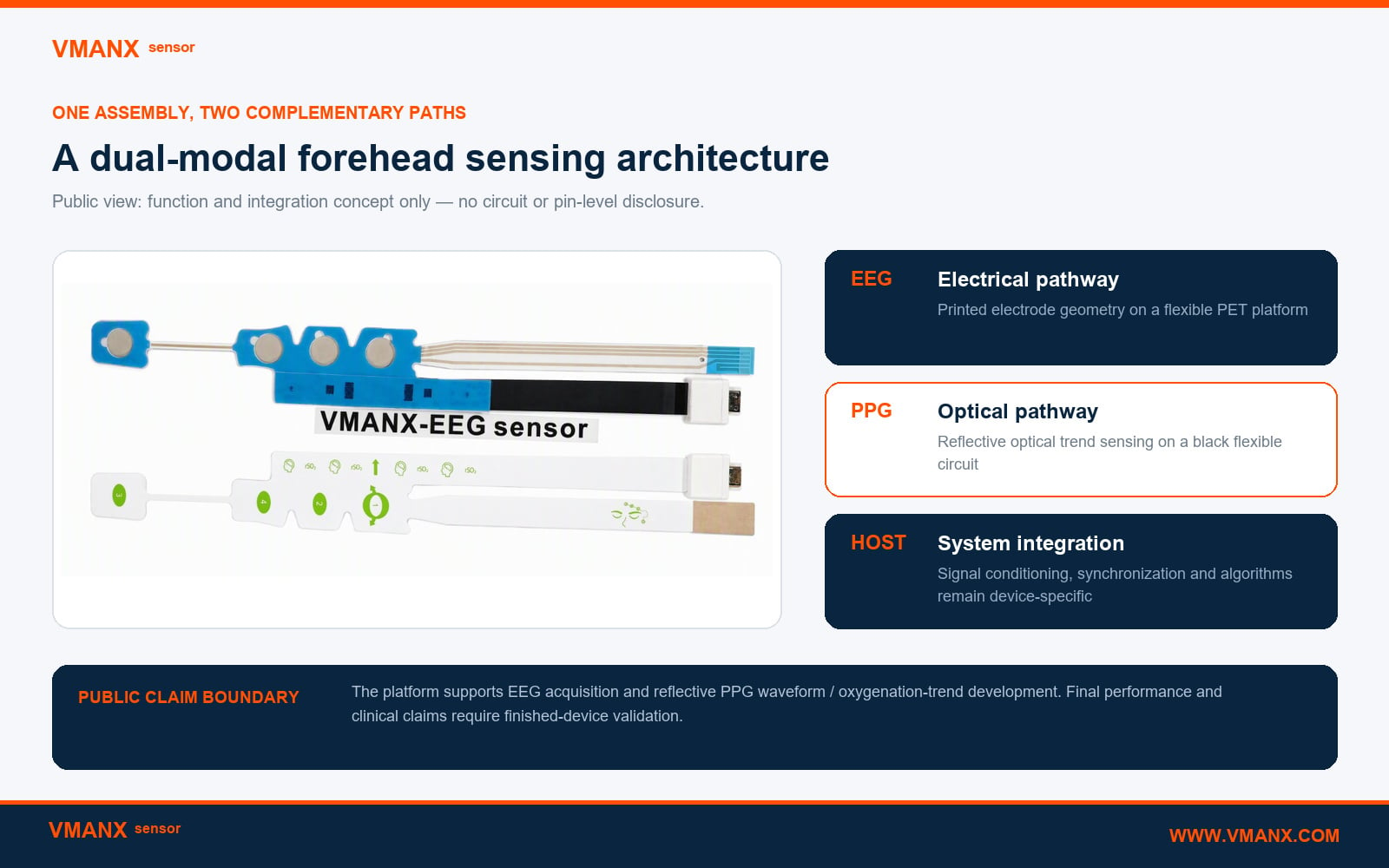
Function-level architecture for public communication. Circuit and pin-level details are intentionally excluded.
A functionally separated composite structure
The public architecture can be understood as three functional zones:
• Flexible EEG electrode zone — a white PET-based layer carries the printed electrode geometry and routes the biopotential signal toward the host electronics. Electrode layout, contact material and skin-interface construction are defined for each OEM project.
• Reflective PPG optical zone — a black flexible circuit supports the optical emitter and detector arrangement. Light-management features help define the transmit and receive paths while reducing direct optical crosstalk.
• Host-system interface — a compact connector links the composite sensor to the customer’s electronics. Pin definition, signal conditioning, sampling and communication remain project-specific.
This separation is important. EEG performance depends on electrode-skin contact, noise control and differential signal acquisition, while PPG performance depends on optical coupling, ambient-light rejection, motion control and the selected analog front end. The mechanical platform brings both domains together without treating them as the same signal chain.
Hybrid manufacturing: printed electrodes meet optical FPC assembly
Producing the platform requires a hybrid process rather than a single circuit technology. The EEG side begins with flexible-film preparation, printed conductor processing and electrode-pattern definition. The PPG side uses flexible-circuit assembly for optical components and associated interconnects. The two sides converge during alignment and lamination.
• PET-film preparation and surface treatment;
• printing and curing of the EEG conductive pattern;
• assembly and inspection of the optical flexible circuit;
• continuity and optical-function screening;
• registered lamination of the electrode, optical and adhesive layers;
• die cutting, connector integration and final visual inspection.
The image below has been deliberately sanitized for public use. Circuit references, internal identifiers and fine trace information have been reduced to protect project-specific design information while preserving the manufacturing narrative.
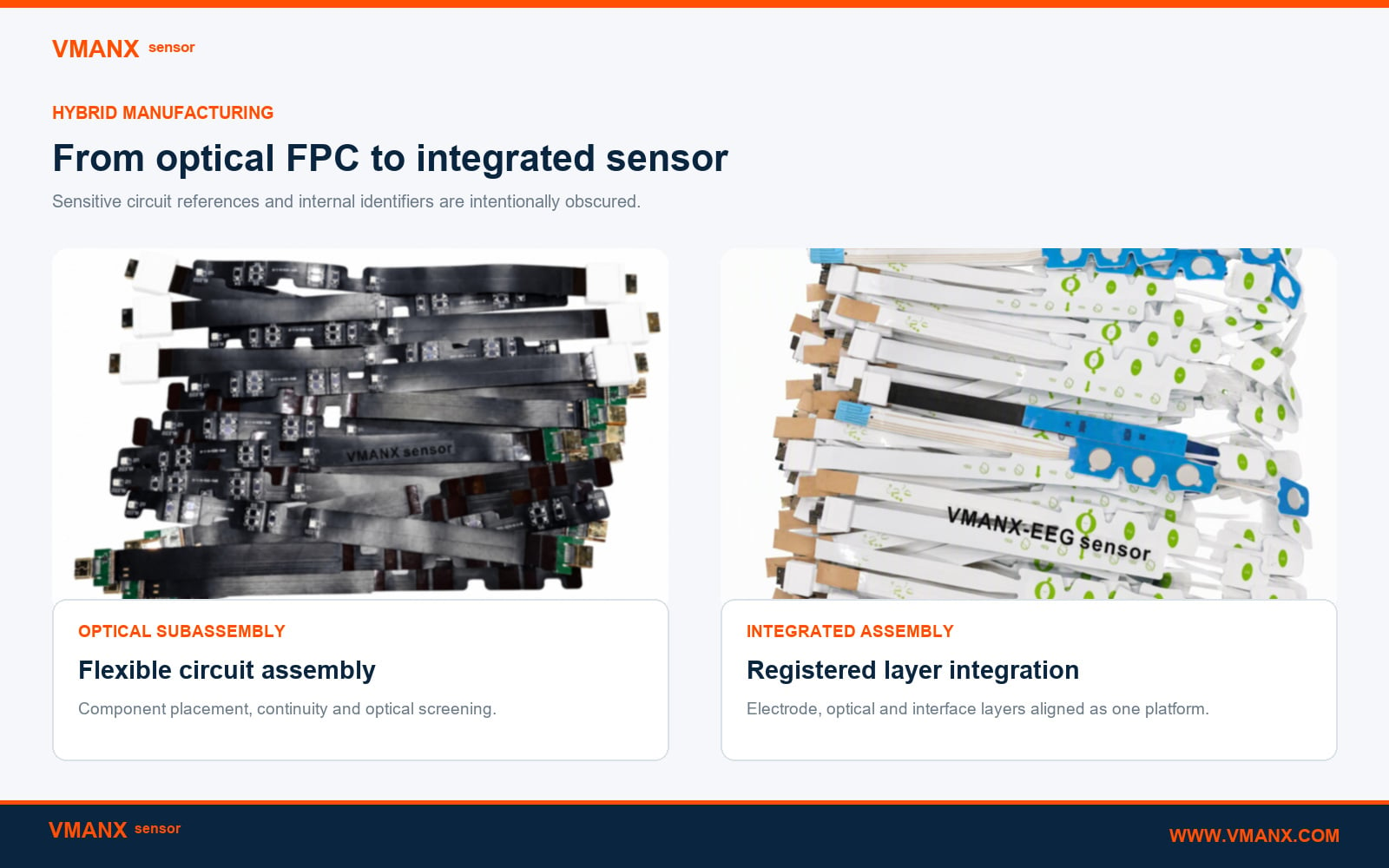
From optical flexible-circuit assembly to registered dual-modal integration.
Engineering priorities for finished-device developers
Because the platform is an OEM component, meaningful performance limits must be established with the customer’s complete system. The main development priorities include:
|
Engineering domain |
Integration focus |
|
EEG signal path |
Electrode geometry, skin-contact system, input impedance, offset stability, noise and channel matching |
|
PPG optical path |
Emitter selection, detector geometry, optical isolation, ambient-light cancellation and motion-artifact strategy |
|
Mechanical design |
Forehead conformity, adhesive selection, flex transition, strain relief and cable routing |
|
Host electronics |
Analog front end, sampling sequence, synchronization, connector definition and power budget |
|
Algorithm and validation |
Signal-quality metrics, trend interpretation, clinical protocol and finished-device performance claims |
The visible connector form is a mechanical interface only. It does not imply a standard USB protocol. Electrical pinout and communication are defined with the OEM host system.
VMANX presents the optical channel as a reflective PPG waveform and oxygenation-trend development path. Specific SpO₂ or regional cerebral oxygen-saturation accuracy is not claimed at the component level; such performance depends on the complete optical stack, electronics, calibration, algorithm and clinical validation.
Application-oriented development
The shared forehead format is relevant to several development contexts where low-profile, synchronized waveform acquisition may be valuable:
• Intensive care — continuous electrical and optical trend acquisition at the bedside;
• Operating room — a consolidated pre-use placement workflow for anaesthesia-monitoring system development;
• Sleep laboratory — long-duration forehead sensing for overnight multimodal studies;
• Neurology and recovery — synchronized electrical and pulsatile optical waveforms in step-down or ambulatory research workflows.
These images illustrate potential workflow contexts rather than approved clinical indications. Final intended use, patient population and performance claims must be established by the finished-device manufacturer.

Illustrative workflow concepts; not approved clinical indications.
OEM development scope
VMANX supports project-specific development around:
• EEG electrode count, spacing and reference location;
• optical emitter/detector arrangement and light-isolation geometry;
• PET and flexible-circuit stack configuration;
• skin-contact adhesive or gel selection;
• flex length, bend zones and strain-relief design;
• connector pin definition and host-system matching;
• inspection planning, traceability and project test documentation.
Development is managed within the VMANX medical quality framework. Patient-contacting materials can be evaluated under the applicable ISO 10993 plan, while RoHS and REACH documentation can be prepared for the released material configuration.
From component platform to validated medical device
The engineering value of multimodal sensing is not created by placing two technologies next to each other. It comes from controlling the mechanical stack, contact conditions, optical geometry, signal paths and host-side synchronization as one development problem.
VMANX is positioning this flexible EEG + reflective PPG platform as an OEM starting point for teams that need a compact forehead interface and want to reduce mechanical integration complexity without blurring the boundary between component capability and finished-device performance.