EN
EN

Bed Exit Sensor for Fall Prevention | VMANX
VMANX, an ISO 13485-certified flexible sensor manufacturer in Dongguan, China, develops bed exit sensors for fall prevention for hospitals, nursing facilities and assisted-living equipment. The system uses a thin pressure-sensing pad beneath a mattress or seat to recognise occupied pressure, edge unloading and confirmed exit, because caregivers need warning while a high-risk resident is still preparing to stand — not after the fall has happened. Configurable thresholds, timed validation and wireless bed or seat identification turn a hidden sensor layer into an earlier and more actionable care response.
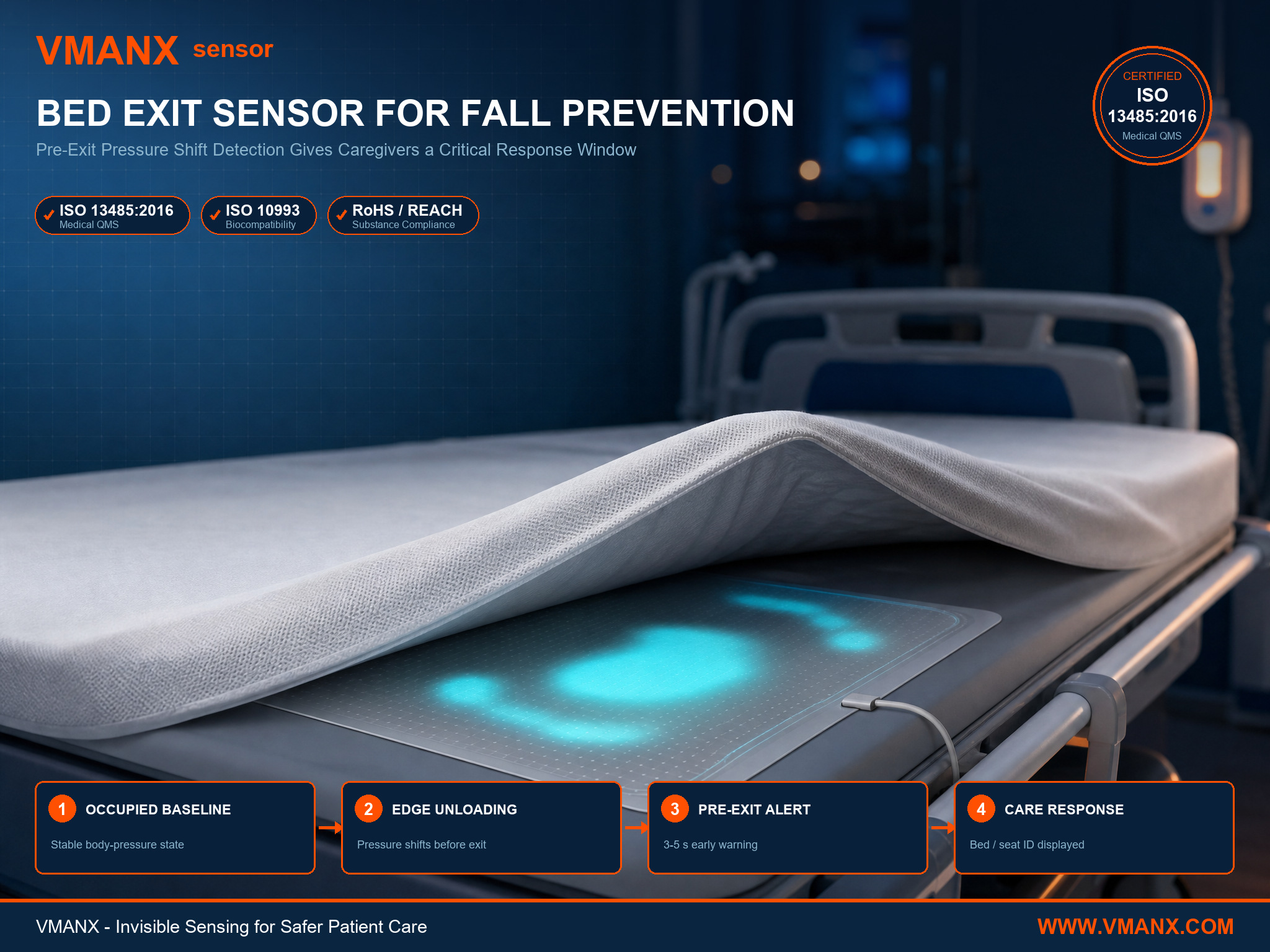
Fall Prevention Starts Before the Patient Leaves the Bed
A conventional bed-exit alarm often treats occupancy as a binary condition: weight present means safe, weight absent means alarm. That logic is simple, but the most valuable care window appears between those two states.
Before a person stands, the pressure pattern changes. Weight moves toward the mattress edge, the centre unloads, and one side of the body begins carrying more of the load. Detecting that transition 3–5 seconds before actual exit gives a caregiver time to move toward the bed, speak to the resident or provide physical assistance.
Three seconds is not a long time in ordinary life. In fall prevention it separates a proactive intervention from an incident report.
Key Features & Benefits
Pre-Exit Pressure Shift Detection Creates a Response Window
The VMANX chair and bed exit sensing platform monitors how pressure redistributes, not only whether total pressure falls to zero. Edge unloading or a sustained shift can therefore trigger a pre-departure warning before complete exit.
The published chair-exit function provides a 3–5 second early-warning window. For a patient with postural instability, medication-related dizziness or limited lower-body strength, that window is the engineering value of the system — it converts an unpredictable movement into a detectable sequence.
Timed Confirmation Rejects Short, Harmless Movement
A patient rolling over, adjusting a pillow or briefly lifting one hip should not create the same alarm as a confirmed departure. The system therefore validates time as well as pressure.
Exit confirmation requires the low-pressure or no-pressure state to persist for at least 2 seconds. New occupancy is accepted only after stable pressure has been present for at least 3 seconds. This prevents bedding, a hand placed on the pad or a momentary posture change from continually resetting or triggering the alarm.
The threshold is also adjustable so that a lightweight resident and a larger adult are not forced into the same calibration window.
Thin Installation Preserves Mattress and Seat Comfort
The standard chair sensor pad is 1.2 mm thick, with 300 × 300 mm and 300 × 800 mm configurations. It sits beneath the seat cushion or mattress surface without creating a rigid ridge the resident can feel.
That invisibility matters in long-term care. A safety feature that changes sleep comfort, seat pressure or transfer mechanics creates a new problem while trying to solve another one. A thin flexible layer adds detection without turning the bed into an instrumented platform.
One Receiver Can Identify Multiple Beds or Seats
The wireless receiver supports up to five sensors simultaneously and displays the corresponding bed or seat ID. The care team therefore receives a location-specific event instead of a generic tone that still requires investigation.
For ward-scale systems, the separate VMANX bed occupancy architecture extends from the sensing mat through a wireless gateway to a dashboard or customer system. Published interfaces include RESTful API, MQTT, Modbus and relay output, allowing connection to nurse-call panels, facility dashboards and IoT platforms.
The Sensor Layer Can Be Built Around the Care Workflow
OEM programs can configure pad dimensions, active area, cable length, connector, sensitivity and alert logic. A chair cushion for assisted transfer does not need the same geometry as a full mattress zone, and a private home-care product does not need the same receiver architecture as a multi-bed ward.
The correct design starts with the clinical workflow: who must receive the alert, how early it must arrive, what motion should be ignored, and what existing system must accept the signal.
The Four-State Care Logic
1. Occupied Baseline
Stable pressure above the configured threshold establishes that the resident is present. The system stores a normal occupied state rather than reacting to every small fluctuation.
2. Edge Unloading
Pressure migrates toward the edge or drops in selected zones as the person prepares to sit up or stand. This is the earliest physically meaningful departure signal.
3. Pre-Exit and Exit Validation
A pre-exit warning can be sent 3–5 seconds before departure. Complete exit is confirmed only after the low-pressure state persists for at least 2 seconds, separating a real departure from a short posture change.
4. Caregiver Identification and Response
The receiver identifies the associated bed or seat. In an integrated system, the event can also pass through relay, MQTT, Modbus or API to the existing nurse-call or care dashboard.
Technical Specifications
| Parameter | Chair / Bed Exit Sensor Pad | Bed Occupancy System |
| Primary Function | Pre-exit warning and confirmed seat/bed departure | Continuous bed occupancy and facility integration |
| Dimensions | 300 × 300 × 1.2 mm or 300 × 800 × 1.2 mm | Application-specific FSR sensing mat |
| Active Sensing Area | 280 × 280 mm or 280 × 780 mm | Configurable by mattress / zone design |
| Detection Logic | Pressure shift, edge unloading, low-pressure confirmation | Occupied / unoccupied state with system reporting |
| Pre-Exit Warning | 3–5 seconds before actual exit | Configurable at system level |
| Exit Confirmation | Low-pressure state sustained for ≥2 seconds | Customer-defined event logic |
| Occupancy Validation | Stable pressure sustained for ≥3 seconds | Calibrated to mattress stack and resident range |
| Threshold | Adjustable | Configurable |
| Installation | Beneath chair cushion or mattress surface | Embedded in or beneath mattress layers |
| Receiver Capacity | Up to 5 sensors simultaneously | Gateway supports up to 50 rooms per unit |
| Receiver Output | Bed / seat ID display, visual / audible alert | Dashboard, RESTful API, MQTT, Modbus, relay |
| Sensor Mat Thickness | 1.2 mm standard pad | 3 mm detection mat |
| Ingress Protection | Configuration-dependent | IP65 detection mat |
| Service Life | Defined by selected pad construction | 50,000+ cycles |
| Supply Scope | OEM sensor component / sub-system | OEM component and integration platform |
Chair-exit and bed-occupancy specifications belong to separate VMANX platforms and must not be interpreted as one universal product specification. Final values depend on pad geometry, mattress or cushion stack, threshold calibration, receiver architecture and customer system requirements.
Reducing False Alarms Without Hiding Real Risk
False alarms are not merely annoying. When a system triggers repeatedly for harmless movement, caregivers begin to delay, mute or mentally discount the next alarm. Sensitivity without specificity can therefore reduce safety rather than improve it.
Three design controls matter:
1. Pressure threshold — bedding or a small object must not look like a resident. 2. Time validation — a brief pressure change must not look like a complete departure. 3. Spatial change — edge unloading is more informative than a single total-force value.
The goal is not to eliminate every alert. The goal is to make each alert correspond closely enough to care risk that staff continue to trust and act on it.
Pressure Sensing vs PIR and Camera Monitoring
PIR detects movement, not continued presence. A resident sitting motionless at the edge of the bed may disappear from a motion-only system at exactly the point where risk is rising.
Cameras provide context but create privacy, lighting and line-of-sight constraints. They may be unsuitable in bedrooms, bathrooms or private care environments, and they require more data processing than a direct load signal.
A pressure sensor answers a narrower question: is this specific bed or seat loaded, and is that load moving toward departure. It cannot identify who is in the room or what they are doing elsewhere. For surface-level exit risk, that narrower question is often the correct one.
Customer FAQs
Q: How early can the sensor warn before a patient leaves? A: The chair-exit platform publishes a 3–5 second pre-departure warning based on pressure shift or edge unloading. The exact response window depends on the resident's movement pattern, pad placement and configured threshold.
Q: How does the system avoid alarms when a patient only rolls over? A: It combines pressure threshold with timed validation. A low-pressure or no-pressure state must persist for at least 2 seconds before confirmed exit, while new occupancy requires at least 3 seconds of stable pressure.
Q: Can bedding or an object keep the alarm from recognising exit? A: The threshold is adjustable so bedding and small objects remain below the valid occupancy level. Calibration must be completed with the actual mattress, cushion and cover stack used in the finished product.
Q: Is the pad uncomfortable under a mattress or cushion? A: The standard chair sensor pad is 1.2 mm thick and is installed beneath the contact surface. Proper placement keeps the sensing layer hidden without creating a rigid point under the resident.
Q: Can one receiver monitor more than one bed or chair? A: Yes. The chair-exit receiver supports up to five sensors and displays the corresponding bed or seat ID. The larger bed-occupancy gateway architecture supports up to 50 rooms per unit.
Q: Can it connect to an existing nurse-call system? A: The bed occupancy architecture supports relay output for legacy panels and RESTful API, MQTT and Modbus for digital care platforms. Final interface selection depends on the customer's nurse-call or facility system.
Q: Is this a finished medical device? A: No. VMANX supplies OEM sensor components and sub-systems under ISO 13485 manufacturing control with ISO 10993 material options. Certification and registration of the finished care or medical device are performed by the manufacturer placing it on the market.
Q: Can pad shape and alarm logic be customised? A: Yes. Pad dimensions, active zones, cable, connector, threshold, receiver behaviour and event timing can be configured for the target bed, chair and care workflow.
OEM Engineering Support
VMANX supports care-safety programs from placement definition and threshold calibration through receiver and nurse-call integration. The medical portfolio includes safety monitoring sensors, while the chair exit sensor pad provides detailed exit-warning logic and the VMANX bed occupancy sensor provides the wider gateway architecture. The underlying force sensing resistor and flexible printed circuit platforms support custom geometry, interconnect and system integration.
Conclusion
A bed-exit sensor cannot prevent every fall by itself. What it can do is convert a hidden transition — pressure moving toward the edge — into a time-stamped event before the resident is fully standing. When early-warning logic, false-alarm controls and location-specific receiver output are engineered together, a 1.2 mm flexible sensor becomes a practical response tool rather than another generic alarm.