EN
EN

FSR Sensor for Medical Force Monitoring | VMANX
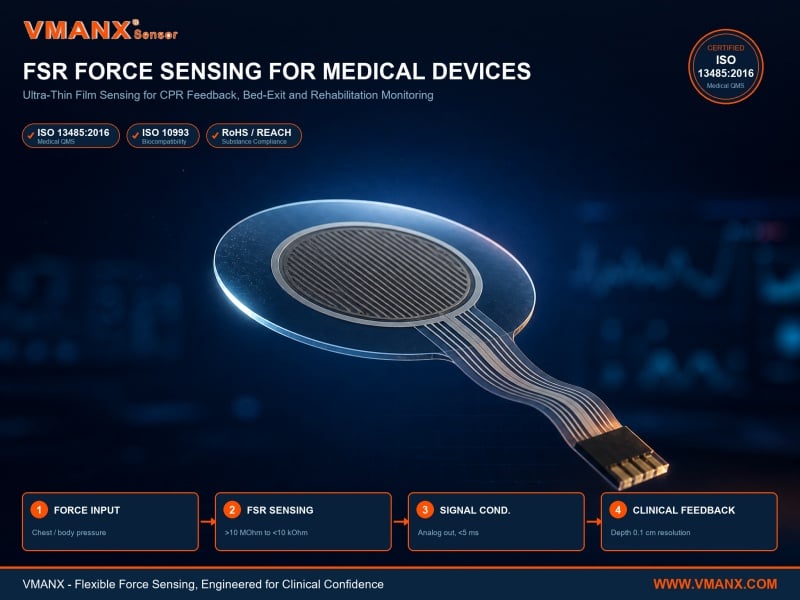
Ultra-thin FSR force sensing resistor for CPR feedback, bed-exit and rehabilitation monitoring devices.
VMANX, an ISO 13485-certified printed electronics manufacturer in Dongguan, China, supplies the CPR-FS01 force sensing resistor (document VF-CPR99139) — an ultra-thin FSR sensor under 0.3 mm thick that converts applied body force into an analog resistance signal for patient-care devices. Built for medical OEMs developing CPR feedback systems, bed-exit alarms and rehabilitation monitors, the sensor resolves chest compression depth to 0.1 cm and responds in under 5 ms, because in resuscitation the difference between effective and ineffective compression is measured in centimetres and milliseconds, not in clinical impression.
Why Force Sensing Belongs in Patient Care
Human judgement is unreliable under pressure. During cardiac arrest, rescuers consistently misjudge both compression depth and rate — pushing too shallow as fatigue builds, or drifting off the guideline rhythm without noticing. The same blind spot exists in ward care: nurses cannot know a patient has left the bed until an alarm tells them, and rehabilitation therapists cannot quantify loading without instrumentation.
An FSR converts that invisible mechanical event into a number a device can act on. Because the sensing element is a printed polymer thick-film structure rather than a machined load cell, it can be under 0.3 mm thick and flexible enough to laminate into a compression pad, a mattress overlay or an insole — instrumenting the contact surface without changing how the product feels to the patient.
Key Features & Benefits
Compression Depth Resolution of 0.1 cm
The CPR-FS01 senses across a range corresponding to 1.5 cm to 8.0 cm of compression depth, with resolution of 0.1 cm and accuracy within ±0.5 cm or 10%, whichever is greater. That envelope brackets the 5–6 cm adult compression depth recommended by emergency guidelines with headroom on both sides.
For an OEM building a CPR feedback device, this means the sensor can distinguish a 4.5 cm compression from a 5.5 cm compression — the exact discrimination that separates a “push harder” prompt from a “good compression” confirmation.
Sub-5 ms Response for Rate and Recoil
Response time is under 5 ms, fast enough to capture the dynamic profile of each individual compression rather than an averaged envelope. From that waveform a device can derive compression rate across 40 to 160 compressions per minute, and verify against the guideline target of 100–120 cpm.
Critically, the sensor also detects full release. When compression force returns to a near-zero state, the device can confirm complete chest recoil — the parameter most often missed in real resuscitation, and the one that determines whether the heart refills between compressions.
Ultra-Thin, Laminate-Anywhere Form Factor
Overall thickness is under 0.3 mm with a 12.7 mm diameter circular active area, supplied with an adhesive backing layer and standard pin interface. A 100 cm two-core shielded cable is standard and customisable, with an optional 3-pin JST-style connector for tool-free service.
This form factor is what makes the same sensing platform reusable across products: laminated under a CPR manikin skin, embedded in a compression feedback pad, integrated into a handheld ALS device, or built into a bed-exit mat or pressure-sensing insole.
Extremely Low Power for Battery Devices
Static power consumption is negligible and typical operating current is below 0.5 mA. For a battery-powered handheld feedback device or a wireless bed sensor, the force sensing layer is effectively free in the power budget — the design constraint moves to the radio and display, not to sensing.
100,000-Cycle Mechanical Life
Under conditions simulating standard CPR compressions at 5–6 cm depth and 110 cpm, the sensor withstands more than 100,000 continuous compression cycles with performance degradation held within 10% of initial value. Repeatability is within ±3.0% of full scale. For a training manikin used daily, that endurance is what separates a consumable from a component.
Technical Specifications
| Parameter | Specification |
| Model | CPR-FS01 (Doc. VF-CPR99139) |
| Sensing Principle | Force sensitive resistor; resistance falls non-linearly with force |
| Structure | Ultra-thin polymer thick-film, flexible |
| Output | Analog resistive; external signal conditioning required |
| Initial Resistance (no load) | > 10 MΩ |
| Full-Scale Resistance | < 10 kΩ at maximum force |
| Response Time | < 5 ms |
| Repeatability | ± 3.0% (full scale) |
| Operating Current | < 0.5 mA typical |
| Depth Sensing Range | 1.5 cm to 8.0 cm equivalent |
| Depth Accuracy | ± 0.5 cm or 10%, whichever is greater |
| Depth Resolution | 0.1 cm |
| Target Depth Window | 5 – 6 cm (adult guideline) |
| Rate Range | 40 – 160 compressions per minute |
| Target Rate | 100 – 120 cpm |
| Recoil Detection | Near-zero force state confirms full chest recoil |
| Active Sensing Area | 12.7 mm diameter, circular |
| Overall Thickness | < 0.3 mm |
| Lead Wire | Two-core shielded, 100 cm, customisable |
| Connector | Optional 3-pin (JST type) |
| Operating Temperature | 0 °C to +50 °C |
| Operating Humidity | 10% – 95%, non-condensing |
| Storage Temperature | -30 °C to +70 °C |
| Mechanical Life | > 100,000 cycles, degradation ≤ 10% |
| Recommended Load Resistor | 10 kΩ – 100 kΩ (application dependent) |
| Quality System | ISO 13485 |
| Biocompatibility | ISO 10993 (patient-contact configurations) |
| Substance Compliance | RoHS 2011/65/EU, REACH |
Typical values. Supplied as an OEM component — whole-device certification is performed by the device manufacturer.
Integration Guidance for Device Manufacturers
The sensor outputs a changing resistance, not a calibrated voltage. A series load resistor converts that change into a usable voltage output, and the resistor value — typically between 10 kΩ and 100 kΩ — should be selected against the force range, ADC input span and sensitivity the application actually needs. Choosing it well is what determines whether the digitised curve uses the full converter range or crowds into a fraction of it.
As a component for medical electrical equipment, the sensor is designed to help device manufacturers meet the standards their finished product must satisfy: IEC 60601-1 / EN 60601-1 for basic safety and essential performance, IEC 60601-1-2 for electromagnetic compatibility, and environmental testing per GB/T 14710 or the equivalent IEC 60068-2 series covering high and low temperature, damp heat, vibration, impact and transport. Whole-device certification remains the responsibility of the manufacturer placing the finished device on the market.
Customer FAQs
Q: What is a force sensing resistor and how does it differ from a load cell?
A: An FSR is a printed polymer thick-film element whose resistance drops non-linearly as applied force increases. Unlike a machined strain-gauge load cell, it has no rigid metal body, so it can be under 0.3 mm thick and flexible. The trade-off is that it outputs a non-linear resistive signal requiring conditioning and calibration, rather than a precision linear output — which suits force-threshold and force-profile applications rather than laboratory-grade weighing.
Q: How accurate is FSR-based compression depth measurement?
A: Within the effective 1.5–8.0 cm range, accuracy is ±0.5 cm or 10%, whichever is greater, at 0.1 cm resolution. This is achieved after system calibration and algorithm processing — the sensor provides the raw force signal and the device manufacturer's algorithm converts it to depth.
Q: Can one sensor cover both compression depth and rate?
A: Yes. Depth comes from signal amplitude and rate comes from the timing of the dynamic waveform. Because response time is under 5 ms, individual compressions remain distinct up to 160 cpm, so depth, rate and recoil are all derived from the same channel.
Q: What applications beyond CPR use the same sensor platform?
A: The same FSR platform supports bed-exit alarms and patient fall prevention, chair-exit and sitting-posture monitoring, rehabilitation and insole pressure measurement, and general tactile force sensing. The sensing principle stays constant while active area, force range and tail geometry are configured per application.
Q: Does the sensor need to contact the patient's skin directly?
A: Usually not. In most designs it sits beneath a pad, mattress cover, manikin skin or insole, so the covering layer is the patient-contact surface. Where a configuration does involve direct or prolonged skin contact, ISO 10993 biocompatibility applies to the contacting materials and is specified during the OEM design phase.
Q: How long does the sensor last in a training device used every day?
A: Mechanical life exceeds 100,000 compression cycles at 5–6 cm depth and 110 cpm with degradation within 10% of initial value. In practical terms a training manikin can run intensive daily sessions for years before drift approaches that limit.
Q: What certification does the sensor carry?
A: VMANX manufactures under ISO 13485 quality management, with RoHS 2011/65/EU and REACH substance compliance, and ISO 10993 biocompatibility for patient-contact configurations. The sensor is an OEM component; IEC 60601 electrical safety and EMC certification is performed on the finished device by the manufacturer bringing it to market.
OEM Engineering Support
VMANX supports medical OEM programs from force-range definition through production release, covering active area sizing, load resistor selection, tail routing, connector choice and lifecycle validation. Full specifications are published on the CPR flexiforce tactile sensor and VF-CPR99139 sensor specification pages, with the wider force sensing resistor range and the medical sensor portfolio covering EEG, EMG, SpO2 and safety monitoring products built on the same flexible printed circuits platform.
Conclusion
Force sensing resistors turn mechanical events that clinicians can only estimate into data a device can act on. At under 0.3 mm thick, below 0.5 mA, with 0.1 cm depth resolution, sub-5 ms response and over 100,000 cycles of life, the CPR-FS01 gives medical OEMs a sensing layer they can laminate into almost any patient-contact surface — manufactured under ISO 13485 control so behaviour repeats from batch to batch.
VMANX — flexible force sensing, engineered for clinical confidence.
Media & SEO Suggestions
Hero image: filename: fsr-sensor-medical-force-sensing-device.jpg | ALT: “Ultra-thin FSR force sensing resistor film sensor for medical CPR feedback and patient monitoring devices”
Video (YouTube): “FSR Force Sensing for Medical Devices — CPR Feedback, Bed-Exit and Rehabilitation | VMANX”
Primary keyword: FSR sensor for medical devices
Secondary keywords: force sensing resistor medical, CPR feedback sensor, compression depth sensor, bed exit alarm sensor, thin film force sensor, medical pressure sensor OEM
Meta description (157 characters): “CPR-FS01 FSR sensor for medical devices: under 0.3 mm thick, 0.1 cm depth resolution, sub-5 ms response, 100,000-cycle life, ISO 13485 manufactured OEM component.”
Certification scope (F1 medical family): ISO 13485 · ISO 10993 · RoHS 2011/65/EU · REACH
Compliance note: OEM component scope. IEC 60601-1 / 60601-1-2 are referenced as standards the finished device must meet — whole-device certification is performed by the customer. Do not add end-device registration claims to this asset.
Publishing note: display the publish date on the news homepage; maintain a 2–4 articles per month cadence.