EN
EN

CPR Force Sensing Resistor (FSR) Test Report
In cardiopulmonary resuscitation (CPR), chest compressions must reach 5–6 cm in depth at 100–120 compressions per minute — with adult compression forces typically between 40 and 60 kg, peaking near 80 kg. The sensor that measures this is not a comfort feature; it is a component in a life-critical feedback loop. Between 15 and 27 August 2026, the VMANX laboratory completed an 11-item reliability testing protocol on the VF-3119-030 flexible FSR force sensor. Every item passed. In parallel, the customer completed a 10-million-cycle compression life test on the integrated device — also passed.
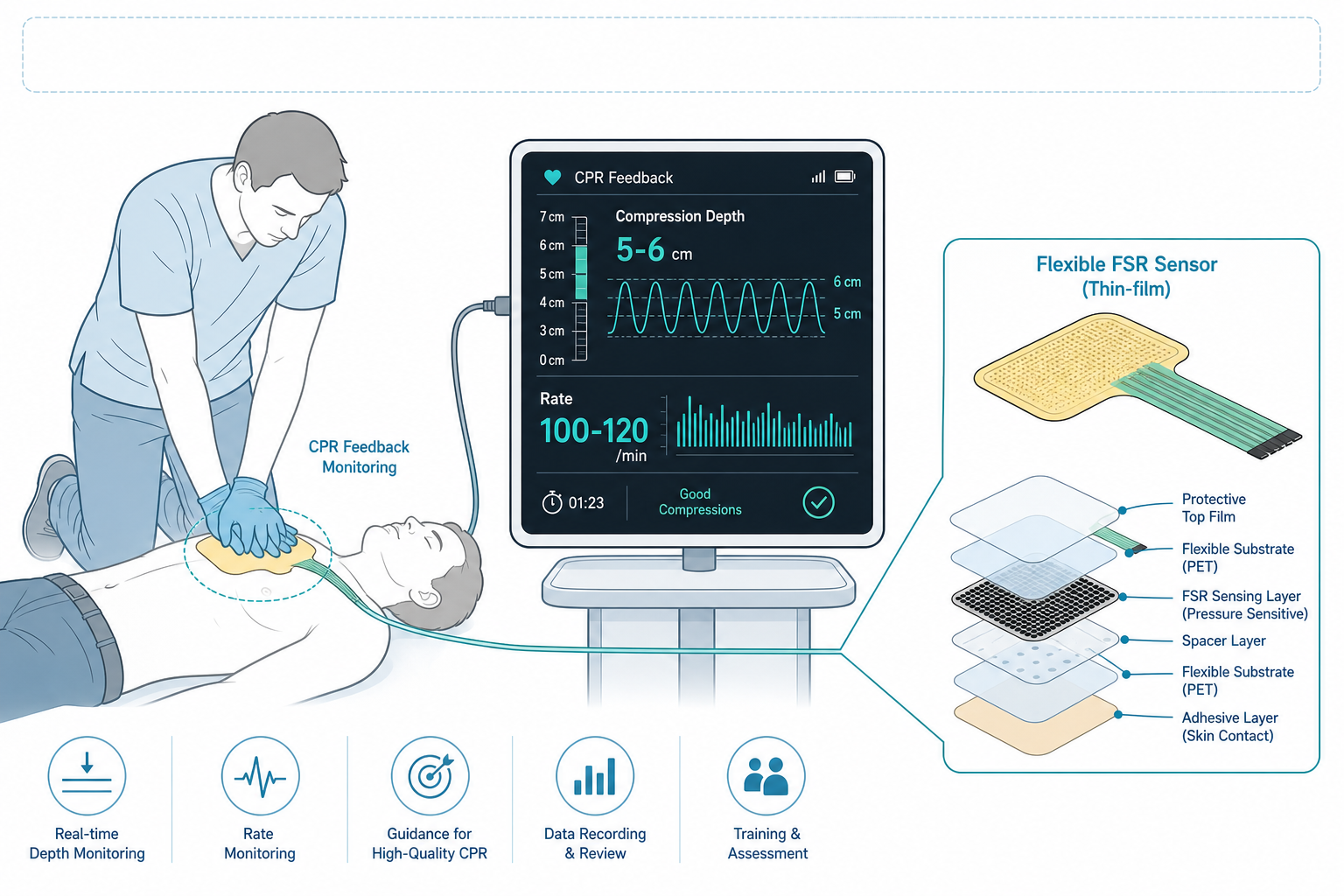
CPR compression feedback: the flexible FSR sensor measures compression force and rhythm in real time
Q1. What does this sensor actually do in a CPR device?
The VF-3119-030 is a flexible thin-film force sensing resistor (FSR). Its resistance decreases monotonically as applied force increases, so the measured resistance can be converted directly into compression force. Placed between the rescuer's hands and the patient's chest — or embedded in a CPR training manikin or feedback pad — it tells the device, and therefore the rescuer, whether each compression is strong enough, and whether the rhythm is being maintained.
In this application the sensor is not measuring a switch press. It is measuring the quality of a resuscitation attempt, thousands of times per device, often in an ambulance, a training room, or an outdoor emergency scene.
Q2. Why does reliability matter more here than in a typical sensor application?
Because the failure modes are silent. A sensor that drifts after ten days of continuous load, or shifts its baseline after a cold night in an ambulance, does not announce itself — it simply reports the wrong force. For a CPR feedback device, that means a rescuer may be told a compression is adequate when it is not.
This is why the VMANX protocol does not stop at "does it work". It asks: does it still work identically after 20 thermal shock cycles between +85 °C and −40 °C? After 240 hours of high and low temperature storage? After ten days under constant 5 kgf load? Is unit #1 the same as unit #10?
Q3. What testing protocol was applied?
Eleven items, executed 15–27 August 2026 in the VMANX laboratory, referencing IEC 60068-2 and ISO 16750 environmental methods. This is the quality and reliability outline we apply to life-critical force sensing components:
| # | Test Item | Condition / Method | Result | Verdict |
| 1 | Trigger force | 10 PCS, full inspection | 4–9 gf (mean 5.9 gf) | PASS |
| 2 | Measuring range | 50–3,000 gf, 10 PCS | 6.47 KΩ @50gf → 1.01 KΩ @3,000gf | PASS |
| 3 | Batch-to-batch consistency | 10 PCS, identical force points | CV ≤ 12.9% (≤ 6% at high force) | PASS |
| 4 | No-load impedance | 10 PCS, before / after climate test | 9.8–11.3 KΩ → 9.9–11.0 KΩ | PASS |
| 5 | Hysteresis error | 3 PCS, loading / unloading 50–2,000 gf | ≤ 2% at 2,000 gf | PASS |
| 6 | Continuous load endurance | 2.5 kgf × 24 h | 1.0–1.1 KΩ, drift < 5% | PASS |
| 7 | Long-term drift | 5 kgf × 10 days, 30 readings | 153.2–160.9 Ω (±2.5%) | PASS |
| 8 | Thermal shock | +85 °C ↔ −40 °C, 20 cycles | Curve profile unchanged, function normal | PASS |
| 9 | High / low temperature storage | −40 °C and +85 °C, 120 h each (240 h total) | Appearance and performance conforming | PASS |
| 10 | Peak force verification | 80 kg applied load | 89.7 Ω, no failure | PASS |
| 11 | Sensitivity calibration | Resistance-to-force correlation | 100 Ω ↔ 27.95 kg | PASS |
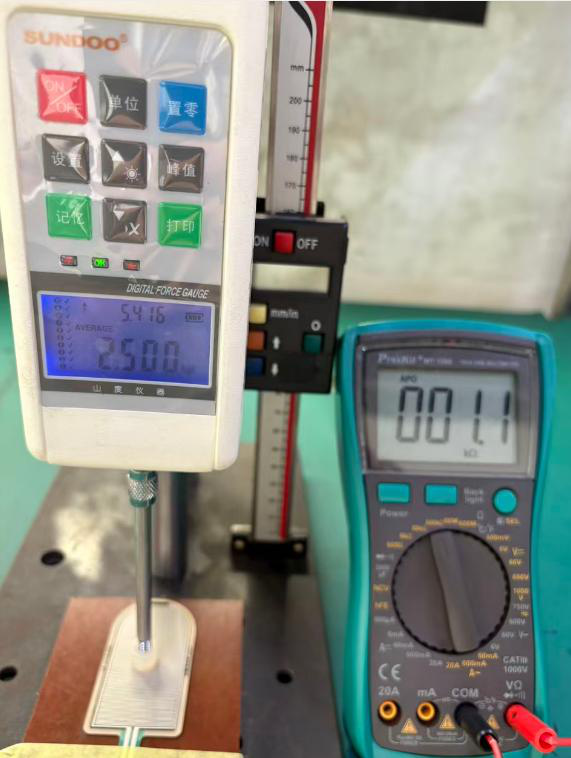
Test setup: SUNDOO digital force gauge with Precision MT-1280 multimeter on a calibrated stand
Q4. Which results matter most for a CPR device engineer?
Three of them.
▪ Range covers the real application. CPR compression forces run to roughly 80 kg at the extreme. At 80 kg the sensor read 89.7 Ω and returned to normal — no saturation failure, no damage. The full curve from 50 gf upward is smooth and monotonic, which is what makes reliable calibration possible.
▪ It does not drift under sustained load. Ten days at a constant 5 kgf produced a total spread of 153.2–160.9 Ω, about ±2.5% — better than the ±4% design reference. A device calibrated on day one is still accurate on day ten.
▪ It survives the environment. After 20 thermal shock cycles between +85 °C and −40 °C, the resistance-versus-force curve retained the same profile and the sensor remained fully functional; after 240 hours of −40 °C and +85 °C storage, appearance and performance were both conforming.
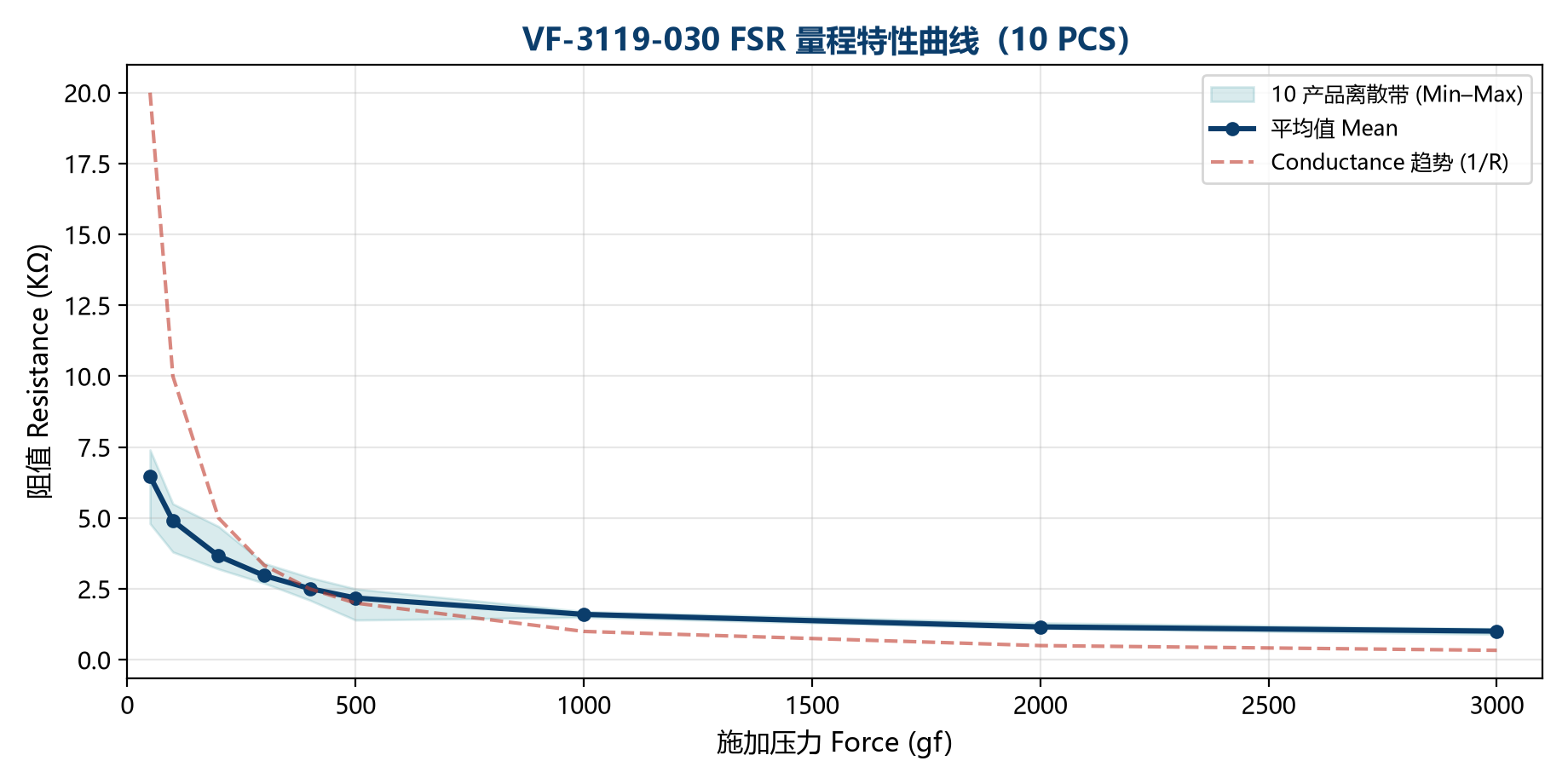
Fig. 1 Measuring range characteristic — 10 PCS, narrow dispersion band, smooth monotonic response
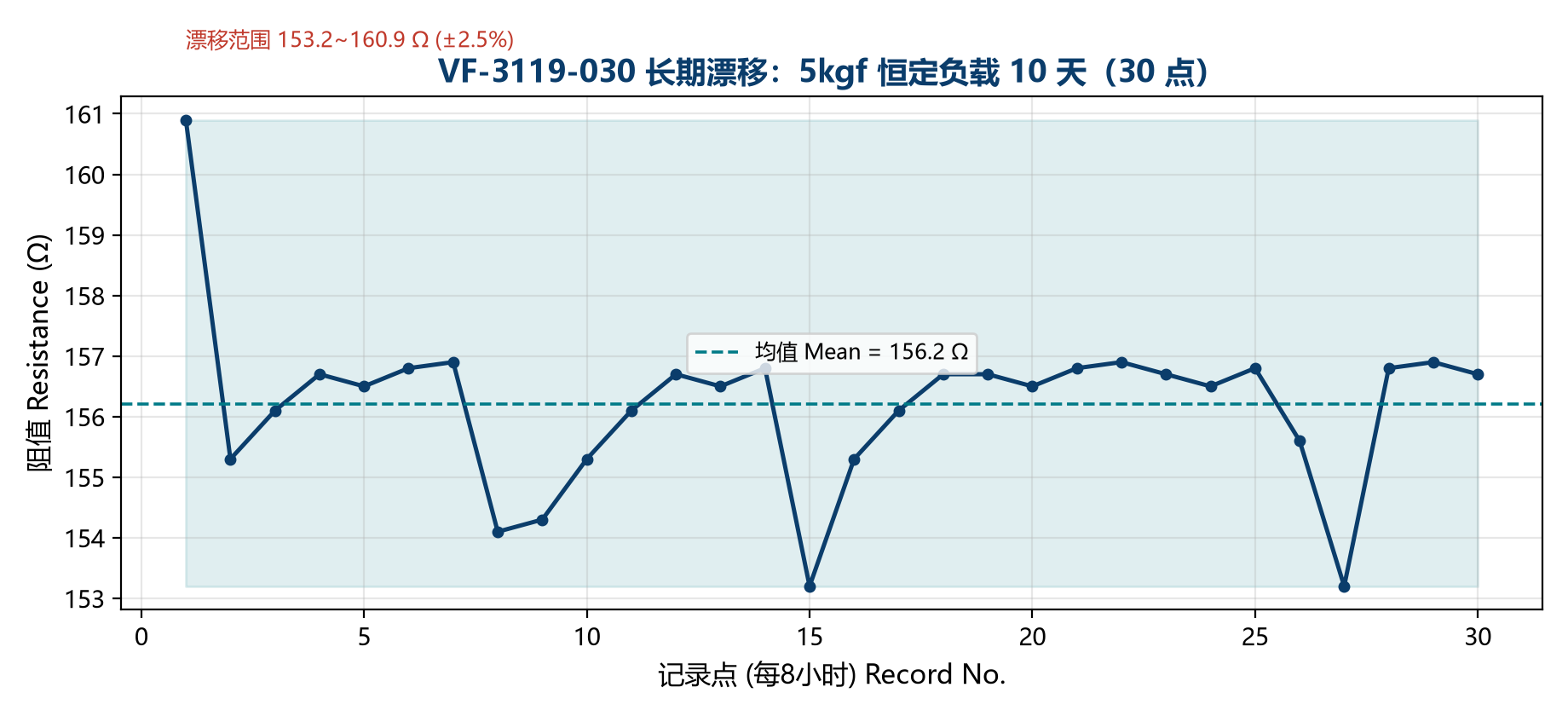
Fig. 2 Long-term drift — 5 kgf constant load over 10 days, total variation ±2.5%
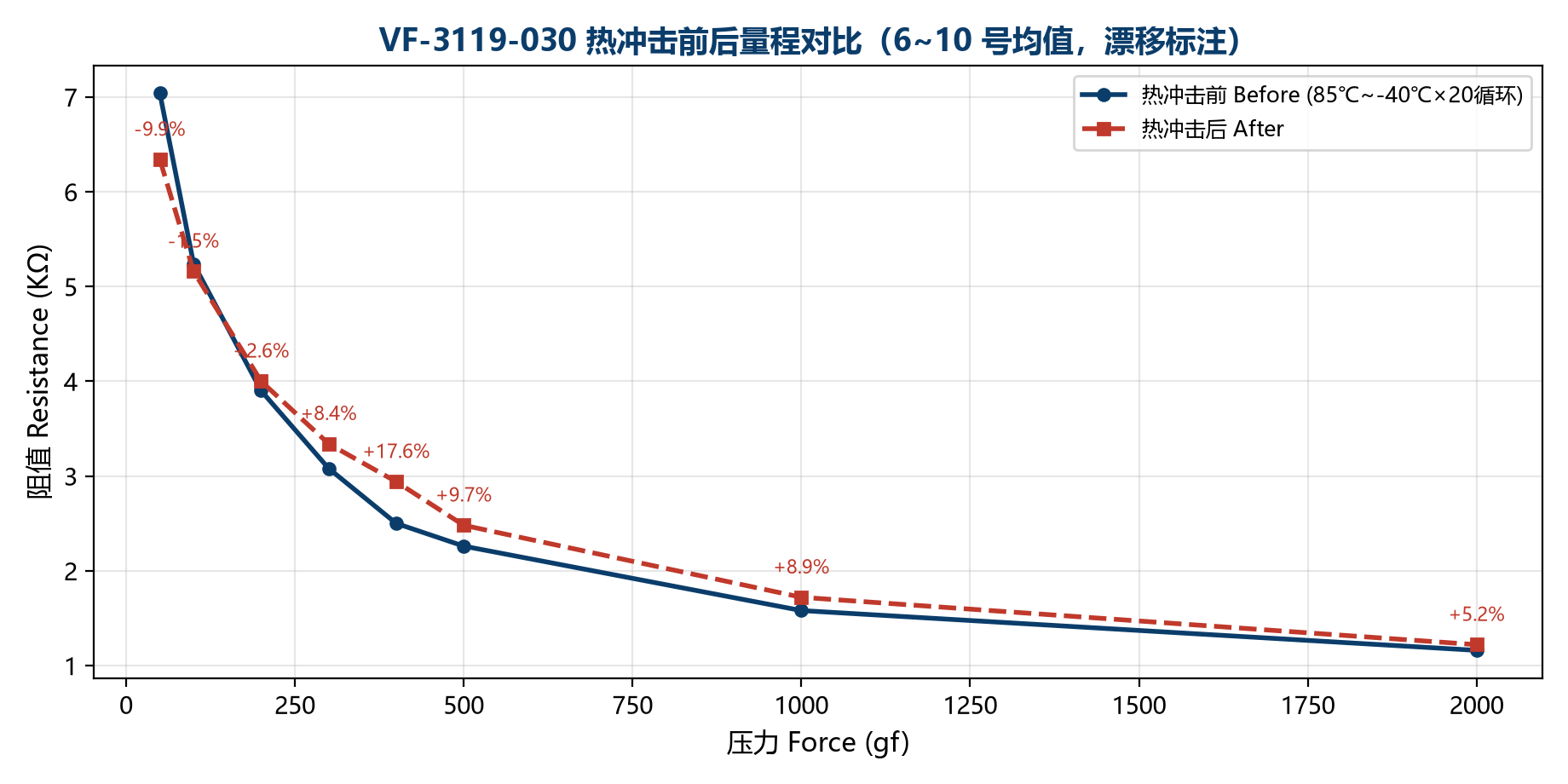
Fig. 3 Thermal shock, before vs. after 20 cycles (+85 °C ↔ −40 °C) — curve profile preserved
Q5. How was long-term durability proven?
By the customer, on the finished device. The customer completed a 10-million-cycle compression life test on the integrated product and confirmed it passed.
To put that number in context: at 100–120 compressions per minute, a full ten-minute resuscitation is roughly 1,000–1,200 compressions. Ten million cycles is therefore equivalent to more than 8,000 complete resuscitation events — well beyond the service life of the equipment it is built into. Laboratory data establishes how the sensor behaves; this test establishes how long it keeps behaving that way.
| Durability Validation | Scope | Result |
| 10,000,000-cycle compression life test | Customer-side, integrated device | PASSED |
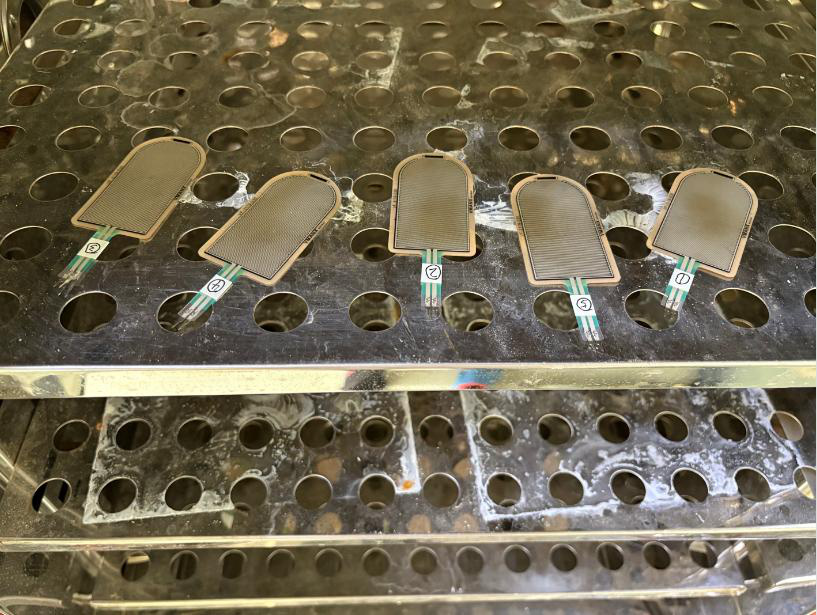
Samples 1–5 inside the HQ-TPH150 temperature/humidity chamber for 240 hours of high and low temperature storage
Q6. What does this mean for a customer evaluating VMANX?
It means the data exists before you ask for it. Every figure quoted above comes from a dated laboratory record — trigger force, range, consistency, impedance, hysteresis, endurance, drift, thermal shock, climate storage, peak load and calibration — and can be supplied as raw test sheets on request.
For medical and life-critical applications, VMANX applies this protocol as standard practice rather than as a one-off exercise. Sensors are characterised across units, not just as a single golden sample; they are stressed environmentally before release; and where the customer runs an independent life test, we align our data with theirs.
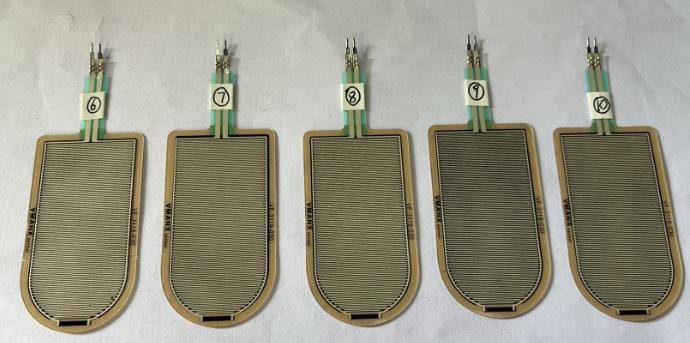
VF-3119-030 flexible FSR force sensor — samples from the tested batch
At a glance
▪ 11 reliability test items — 100% pass rate (15–27 Aug 2026)
▪ Trigger force 4–9 gf | range verified to 80 kg (89.7 Ω, no failure)
▪ Long-term drift ±2.5% over 10 days at 5 kgf constant load
▪ Functional after 20 thermal shock cycles (+85 °C ↔ −40 °C) and 240 h climate storage
▪ Customer-verified 10,000,000-cycle compression life test — passed