EN
EN

ISO 13485 Medical Sensor Manufacturing | VMANX
VMANX, a flexible sensor manufacturer founded in 2006 and operating from Dongguan, Shenzhen and Hong Kong, builds its medical sensor range under an ISO 13485 quality management system — the standard that governs how medical device components are designed, documented and traced. Device OEMs specify certified suppliers because a sensor that performs perfectly in a sample but drifts in month nine is not a component problem, it is a recall. With nearly 20 years of printed electronics practice and 25 national patents, VMANX applies that system across its electrode, force-sensing and medical HMI lines.
Why ISO 13485 Is Not Just ISO 9001 With a Medical Label
Both standards describe a quality management system, and both require documented process control. The difference is what they optimise for.
ISO 9001 is built around customer satisfaction and continual improvement. ISO 13485 is built around regulatory compliance and risk management — and it deliberately drops the continual-improvement emphasis in favour of maintaining a validated, unchanged process. In medical manufacturing, an unannounced “improvement” is a hazard, not a benefit. If a supplier silently switches an adhesive to a cheaper equivalent, a device that passed biocompatibility testing last year may no longer be the device that ships this year.
That single philosophical difference cascades into everything a device OEM cares about: change control, material traceability, batch records, and the ability to reconstruct exactly how a specific lot was built two years after it shipped.
What the System Actually Controls
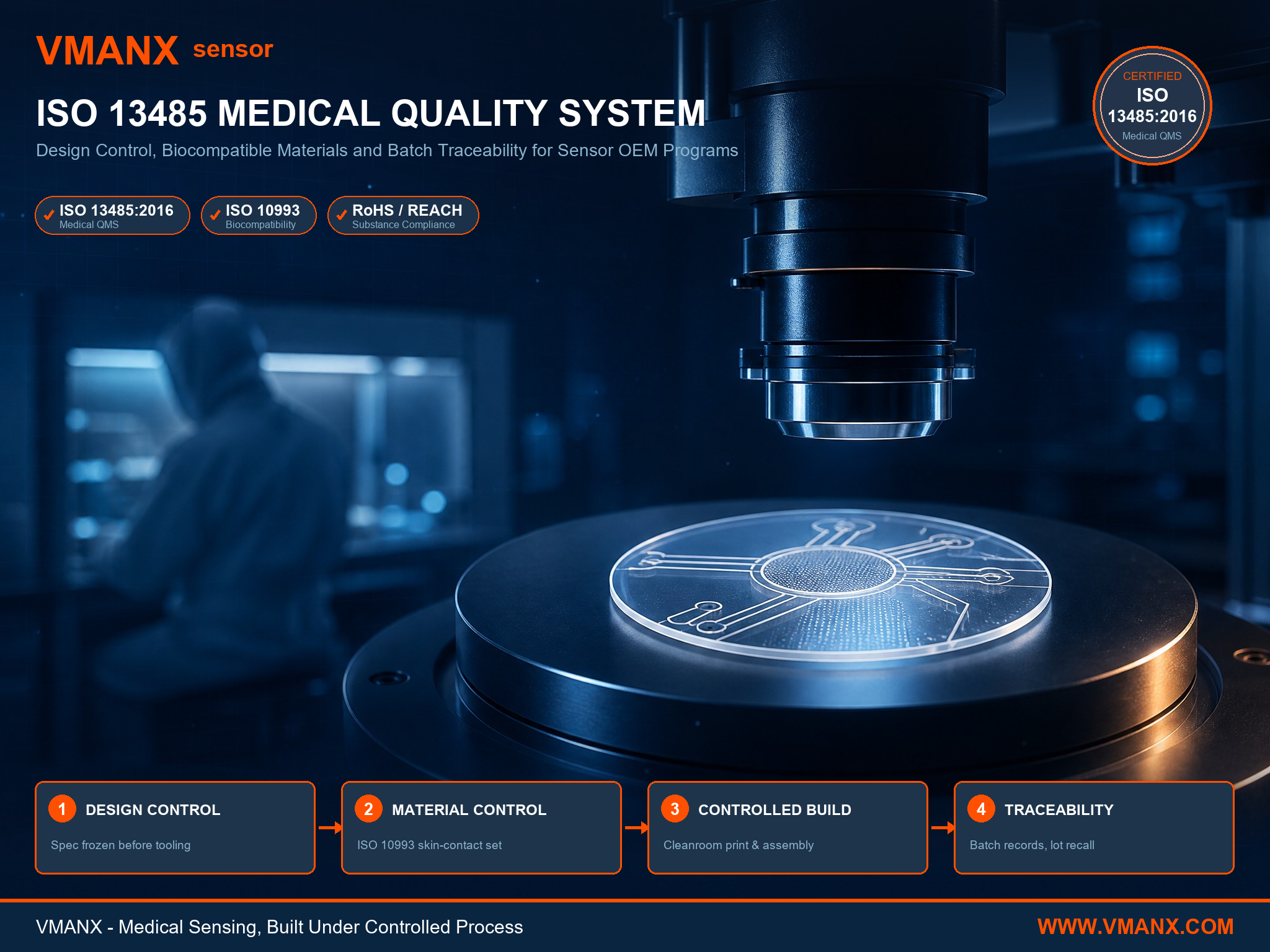
Design Control — Specification Frozen Before Tooling
Under design control, requirements are defined, reviewed and verified before manufacturing tooling is committed. For a sensor program this means the electrical envelope, materials, dimensions and acceptance criteria are agreed and recorded up front, not negotiated during production.
The practical benefit for a device OEM is predictability. When the specification is frozen and documented, the part that arrives in mass production is the same part that passed the customer's design verification — and any deviation requires a formal change process, not an email.
Material Control — Biocompatibility Is a Sourcing Decision
For anything that touches skin, ISO 10993 biocompatibility applies to the contacting materials: the adhesive, the substrate, the gel, the overlay. Meeting it is not a test performed once and forgotten; it is a controlled bill of materials where each skin-contact material is specified, sourced from an approved vendor, and locked against substitution.
This is where certified and uncertified suppliers diverge most sharply. An uncontrolled supply chain can swap a foam adhesive for a visually identical one at any time. Under a medical QMS, that substitution is a controlled change requiring evaluation — because the new material has not been through the same biological evaluation as the one it replaces.
Controlled Build — Cleanroom Printing and Assembly
Medical sensors are manufactured in a controlled environment because particulate contamination affects both print quality and patient safety. Screen printing of conductive layers, die-cutting, gel application and pouch sealing all happen under defined environmental and process parameters rather than best-effort shop conditions.
Process control also means the parameters themselves are recorded. Print thickness, cure profile, cut tolerance and seal integrity are monitored to specification, so a batch that drifts is caught in-process rather than discovered by the customer.
Traceability — Reconstructing a Lot Years Later
Batch records tie a finished lot back to its material lots, production parameters and inspection results. If a field issue emerges, the affected population can be bounded precisely instead of conservatively.
For a device manufacturer this is the difference between recalling one lot and recalling a year of production. Traceability is the least visible part of a quality system during supplier selection, and the most valuable part the day something goes wrong.
Where the System Is Applied
VMANX applies its medical quality system across the full medical portfolio:
● EEG sleep monitoring and disposable EEG sensors — brain-wave monitoring electrodes for ICU and sleep laboratory use
● EMG throat reactive electrode sensors — including laryngeal tube electrodes for recurrent laryngeal nerve monitoring
● Disposable SpO2 sensors — single-use pulse oximetry sensing
● CPR flexiforce tactile sensors — compression depth and rate feedback for resuscitation devices
● Medical device membrane switches — sealed, cleanable control panels for medical equipment
● Safety monitoring sensors — bed and chair occupancy sensing for patient care
● Pocket NMES muscle stimulators — neuromuscular stimulation devices
The same design control, material control and traceability discipline governs each line, which is what allows a customer to move from one product family to another without re-auditing the supplier from zero.
Technical Specifications
| Parameter | Detail |
| Quality Management System | ISO 13485 |
| Biocompatibility Standard | ISO 10993 (skin-contact configurations) |
| Substance Compliance | RoHS, REACH |
| Additional System Held | ISO 9001 (general manufacturing lines) |
| Company Founded | 2006 |
| Experience | Nearly 20 years in touch-sensing electronics |
| Operations | Dongguan, Shenzhen and Hong Kong |
| Patents | 25 national patents |
| Customer Base | 100+ established brands |
| Service Model | One-stop: structural design, circuit layout, precision assembly |
| Design Proposal Lead Time | 2 days |
| Prototyping Lead Time | 3–5 days |
| Mass Shipment Lead Time | Within 10 days |
| Medical Product Lines | EEG, EMG, SpO2, CPR force sensing, medical membrane switches, safety monitoring, NMES |
| Supply Scope | OEM components and sub-assemblies |
Typical values. VMANX supplies OEM components; certification and registration of the finished medical device are performed by the device manufacturer placing it on the market.
What Certification Does and Does Not Cover
This distinction matters more than most supplier literature admits.
ISO 13485 certifies the manufacturer's quality management system. It confirms that design control, material control, process control and traceability are documented and audited. It applies to how VMANX builds components.
It does not certify the finished device. Market authorisation for a complete medical device — the registration that permits sale in a given jurisdiction — is held by the company that places the device on the market. A component supplier cannot hold it on the customer's behalf.
Why this is stated plainly: a supplier that blurs the line invites an avoidable problem during the customer's own regulatory review. The correct position is that a certified component supplier makes the device manufacturer's submission easier by providing controlled, documented, traceable parts — while the submission itself remains the manufacturer's responsibility.
Customer FAQs
Q: What is ISO 13485 and why do medical device OEMs require it?
A: ISO 13485 is the international quality management system standard for medical devices. OEMs require it from component suppliers because their own regulatory obligations extend into the supply chain — they must demonstrate that critical components are produced under controlled, documented, traceable conditions.
Q: How is ISO 13485 different from ISO 9001?
A: ISO 9001 emphasises customer satisfaction and continual improvement. ISO 13485 emphasises regulatory compliance, risk management and process consistency, and deliberately de-emphasises unannounced improvement — because in medical manufacturing an uncontrolled change to a validated process is a risk rather than a gain.
Q: Does ISO 13485 certification mean the sensor is approved for medical use?
A: No. It certifies the manufacturing quality system, not the finished device. Market authorisation for a complete medical device is obtained by the manufacturer placing that device on the market. A certified component supplier supports that process with controlled and documented parts.
Q: What does ISO 10993 cover?
A: ISO 10993 governs the biological evaluation of materials that contact the body. For sensors it applies to skin-contact materials such as adhesives, substrates, gels and overlays, and is managed through a controlled bill of materials rather than a one-time test.
Q: Can materials be substituted during production?
A: Not silently. Under a medical quality system, material substitution is a controlled change requiring documented evaluation, because a replacement material has not been through the same biological and performance evaluation as the one it replaces.
Q: How does traceability help if a field issue occurs?
A: Batch records link finished lots to their material lots, process parameters and inspection results. This allows the affected population to be bounded precisely, which typically means containing a specific lot rather than a broad, conservative recall.
Q: Are the same certifications applied across every VMANX product family?
A: No, and that is deliberate. Each product family is manufactured under the quality system appropriate to its sector — medical lines under ISO 13485, other sectors under their own applicable systems. Certifications are not interchangeable across families, and VMANX does not present a medical certification as covering a non-medical line or the reverse.
Q: How quickly can a medical sensor program move from concept to supply?
A: VMANX offers design proposals in 2 days, prototyping in 3–5 days and mass shipment within 10 days. For medical programs, design control activities and material qualification are completed before tooling commitment, so speed comes from a defined process rather than from skipping steps.
OEM Engineering Support
VMANX supports medical OEM programs end to end — from requirement definition and material selection through design verification, pilot build and production release. Company background is published on the about us page, with the full component range across the medical portfolio built on the same flexible printed circuits platform.
Conclusion
Certification is not a badge, it is a description of how a factory behaves when nobody is auditing. Design control that freezes a specification before tooling, material control that blocks silent substitution, a controlled build environment, and traceability that can reconstruct a lot years later — these are what a device OEM actually buys when it specifies an ISO 13485 supplier. VMANX applies that system across its medical sensor lines so behaviour repeats from batch to batch.